Showing posts with label Audi. Show all posts

Wednesday, January 26, 2011

100 Years of Rallye Monte Carlo

100 years ago the first Rallye Monte Carlo was started. Challenges, rules and setup changed from year to year and initially it was more a reliability and regularity test than a speed race. Only in the 60ies they invented the special sections where speed was king. From time to time they invented funny rules, such as the more people you have in the car you more points you gain, or a design evaluation where Coupés were more valuable than Convertibles. Most of us probably remember the times of the Mini Cooper, Alpine A110, Porsche 911, Lancia Stratos, Audi Quattro and the Group B.
On zwischengas you find an article for each year and plenty of pictures (in total more than 200) and it's quite interesting to see the winners and losers coming and going.

Friday, October 29, 2010

Have we gone beyond the tipping point in automobile engineering?

Recently I was involved in a discussion on whether we have gone beyond the tipping point in automobile engineering. The question discussed was whether future cars will not be "truly" better than the cars produced today and points mentioned where things such as engine downsizing, cars getting heavier and heavier, more and more electronics taking away the fun from driving, noise restrictions, emission regulations enforcing direct fuel injections, etc..
Of course you can have many different perspectives here. Let me just mention a few:
(I) The best cars are the ones from the last decade. Cars like the Audi RS4/SE, BMW M3, Porsche 911 Carrera GT3/GT3 RS, Audi RS8 V10, Lamborghini Gallardo Superleggiera, maybe even the Bugatti Veyron, etc. have set the bar and shown what is feasible. With new laws and restrictions you can only make it worse, but barely better.
(II) The best cars come from the 50ies and early 60ies, as then racing and competition cars (especially GTs and prototype type two seaters) could be driven on the road and offered maximum driving pleasure and a great sound spectrum. Take a Jaguar C-Type or a Porsche Carrera 6 as example. And don't think about convenience and usability.
(III) The best cars are still to come as with modern computer technology they will be extremely safe, extremely convenient taking over most/all of the driver's activivities and offer full access to web, TV, sound and entertainment while moving from A to B.
All of the three perspective have some "raison d'être". And for all there are exceptions and counter arguments of course. It's all a matter of what you want and value.
However there are some facts out there as well. The Volkswagen V6 engine built into the R32 for example offered an incredible sound, which the new 4 cylinder Golf R can't match. On the other side modern sound engineering and computer controlled exhaust systems in cars such as the Maserati coupé or the Aston Martin DBS/DB9 enables interesting noise patterns as well. Or just listen to a Ferrari 430 Scuderia. And it's obvious that the current cars offer superior road handling thanks to electronics, modern tyre technology and great suspension design. And it's also clear that weight spoils driving pleasure to some extent, so a 600kg sportscar of the 60ies has certain advantages against a 2 ton Aston Martin, even if the advantage doesn't translate to better lap times.
So, it's a wide topic or as you can say in German "das ist ein weites Feld". Enjoy what you like best and let room for the others with different opinions.

Wednesday, October 27, 2010

German electrical car with a range of more than 600 km

It's not first of April, so maybe it's true. Apparently German companies (lekker engery, DBM energy) built an electrical car that can go more than 600 km (they did 605 km to prove this) and can be recharged within an hour (or in 5 minutes under optimal conditions). The technology used for the battery is new and is based on lithium metal polymer structures. The whole battery weighs only 100 kg. The car used is an almost vintage Audi A2 and still offers seats for 4 people and space for the luggage. This almost sounds like a miracle! Sadly enough the battery technology is not yet production ready and of course many questions can be raised. But if eventually something like this can be manufactured in large numbers then this provides interesting parameters for the design of future cars! Think about small electrical motors, relatively small and light batteries. Let's see!

Thursday, July 29, 2010

Are Audis a renaissance of the body in different sizes like Devins or Buchanans?

Yes, this is the brand new Audi A7. You wouldn't have noticed? It looks like all the other Audis, specifically the A5 Sportsback or the A4? No, it's really a different car, even if you don't notice. For example, it's longer than the other mentioned. But having been mistaken myself, I honestly must say, they really look alike a lot.
It's almost as if the successful practice of Bill Devin producing many different (fiberglass) bodies with the same shape fitting different chassis and sizes is coming back. You want an Audi? Do you want 4.2, 4.5, 4.7 or 4.9 meter length? Well, then take this one or that one, they all look the same basically. It's like buying jeans, you have picked the brand, now it's about size. I think this is the wrong strategy with cars, especially with such expensive cars. And it's a bit boring and lacks imagination and innovation as well. BMW does a bit the same, but at least the different cars have more unique design features, same with Mercedes. I prefer cars that look unique and special, that's probably the reason why I like older cars so much ....

Sunday, June 13, 2010

Audi triumph at Le Mans 2010

Rarely there has been more suspense and excitement at the 24 hours of Le Mans. What looked like a probable victory for the fast Peugeots turned into a threefold triumph for the Audi diesel race cars. What a victory. So much drama. Reliability wins over speed. After 22 hours the last Peugeot disappeared.
What also is clear that not the most beautiful cars have won, but the most efficient and effective package. A surprise is certainly the Ferrari 430 coming in second in GT2 and to some extent the Saleen winning the GT1 class.

Wednesday, June 2, 2010

Audi thinking about bringing A2 back

Apparently Audi is thinking about the Audi A2 back. The A2 was a quite innovative car with less than 900 kg and a fuel efficient engine. However, it didn't sell to well, which was, I think, because of the fairly ambitious price and the less than exciting design. Anyway, the new A2 is supposed to be much more modern and coming with electrical power. What is even more new though, is the idea to build one version of the hardware only, sold at a standard price and have the customers customize their car with "applications". For this Audi builds an "app store", similar to what Apple is doing so successfully. But the Audi apps will not only allow to customize the color of the dials, but also to enable functions built into the hardware. You want a seat heating? Download an app for let's say 300 USD and you can actually switch on the already built in heater. Now this creates a number of issues, I think:
First, I wouldn't want to buy complexity for features I will not use (download). Every additional piece of technology makes cars more complex and more heavy usually.
Secondly, it makes me feel stupid that I buy something, have it, but can't use it, because I don't have the permission as I didn't download the app. If it's pure software functionality then this may be okay, but if it's hardware? However we have already had this and the whole engine chip tuning industry lives from the same concept.
Thirdly, I wonder how long we have to wait until you find instructions on how to "jailbreak" your Audi A2, hack into the "operating system" and free all these available features using an "illegal" approach. And how long will it take until legal battles are fought whether the warranty can be canceled if somebody jailbreaks the software.
Let's see ...

Monday, May 17, 2010

ADAC 24 Hours of Nurburgring 2010 - BMW and Ferrari win, Porsche and Audi suffer

This year's 24 hours of Nurburgring showed as always a very diverse starting grid. A highlight was the Porsche 911 Hybrid racer that almost won the race, but retired after 20 hours or so. As some of the Audi R8 LMS also suffered from various problems the victory was with BMW and its M3 GT2 car no 25. Second came in the Ferrari 430 GTC as a surprise, it was the first start of the 430 at the 24 hours of Nurburgring. A couple of Audi R8, Porsche GT3 and BMW (M3, Z4 GT3) completed the first eleven. Twelfth was the Nissan Z33 with nine laps behind the winner. And thirteenth was a Porsche GT3 RS, a street legal car, impressive! 16th was the Volkswagen Scirocco GT 24-CNG (-80% CO2), 18th the Lexus LF-A, 19th the Opel Astra OPC, 27th the first Aston Martin Vantage V8, 30st a Honda S2000. Interesting also the car coming in as 34st, it was a four door Aston Martin Rapide, driven by the Aston CEO Ulrich Bez and a couple of other chaps. The Lotus Exige burnt down in the morning, but the Ginetta G50 GT4 arrived after 112 laps, noting that the winner finished 154 laps. Average lap times of the front running cars were between 8:30 and 9:00 for the 25.378 km long track (Nordschleife and Grand Prix course coupled). As always there were hundred thousands of fans around the track making this event to a week long party. It's a unique race and probably one of the largest racing events overall on a worldwide scale, no wonder that so many prominent drivers join the race every year.

Sunday, May 2, 2010

Audi sharpens R8 - Audi R8 GT

Based on the success of the R8 race version Audi created the Audi R8 GT. It's 100 kg lighter then its sisters, but the v10 engine gained 40 hp. With almost 200'000 Euros it's quite expensive, but comes fully equipped with what you may need. You can even order a race version with a four point harnesses, roll cage, fire extinguisher and cut off switch.
It clearly proves that you can make this car lighter. Now, coming back to earlier posts, let's take that lesson, but replace the heavier V10 with a light V6, get rid of the 4 wheel drive system and we would have a really exciting car that probably could almost match the performance of its sister cars. But as we can see, for the time being Audi goes the other way by adding exclusivity and horse power.

Saturday, April 24, 2010

Picture of the week - Auto-Union C-Typ

It almost looks like an animal, or a bat mobile. The Auto-Union C-Typ. The picture was taken at the 2009 GP Suisse.
Modern race cars don't have this amazing details anymore. Too bad!

Tuesday, March 9, 2010

True colors at the Geneva Car Show 2010?

In my introduction blog post on this year's Geneva Car Show 2010 I made the point that the most popular color for the cars displayed was white. Of course there were other colors, and I don't mean silver, grey or black. We actually had REAL colors. I put together a sample here. There were some brave car manufacturers bringing really colorful cars to Geneva. Ford for example had this cherry red color. Renault displayed gordini blue and yellow cars. Alfa-Romeo of course had red colors on their booth. There were golden and brownish cars too. And the Ferrari Hy KERS came in this shameless green tone. There is of course a good reason why cars at a car show are not painted in the beloved black or dark grey metallic color schemes. It just doesn't look great with the typical artificial light at an exposition and you can't really see the shape and design well. In that sense white makes a lot of sense, however it doesn't suit all cars well.

Tuesday, February 23, 2010

The new Audi RS5 - more than what we need?

It took Audi quite a bit of time, but now it's here, or will be here. At the coming Geneva Autoshow Audi is supposed to present the new Audi RS5. It features a high revving V8 engine with 450 HP and 430 NM, accelerating the car in less than 5 seconds from 0 to 100 km/h. It comes with all the usual Audi features such as four wheel drive, double clutch seven speed gearbox and launch control. It's almost Ferrari F40 performance for you everyday trip to the office. Now, my readers know from earlier postings, that I am not really a fan of the current "bigger - heavier - faster" trend. It's actually impressive that Audi seems to be able to stay below 1.8 tons. But still, given the average speed on today's street is barely more than 130 km/h (even in Germany) you may wonder whether you need such a machine. Why not go for a nice A4 Avant 2.0 TFSI and a Morgan Plus 8, coming at the same price as a well spec'ed RS5 together, but delivering undoubtedly more fun and causing less depreciation also? Don't get me wrong, the RS5 is gorgeous and certainly fun to drive, but for a Sunday afternoon blast a Morgan is so much more fun and for the commute to the office the A4 does the job.

Friday, January 29, 2010

Why buying expensive cars doesn't make economical sense

When you were making a decision in the 60ies or 70ies whether to buy a Mercedes versus a Skoda, or a Seat versus a Volkswagen, you were facing very different cars with a huge gap between them in terms of engineering, features and quality. Today this is quite different! If you want for example to buy a station wagon and have to decide between a Volkswagen Golf Variant, an Audi A3/A4 Avant/Sportsback, a Skoda Octavia or a Seat Exoto ST then you will see that actually a lot of the components (engine, transmission, suspensions, navigation system, etc.) are shared between some of these cars, thanks to the Volkswagen platform strategy. Not even the quality is too different, actually all these cars are on a high standard. But still, there's a huge price difference between the cheapest and the most expensive car of these four. When you do the same thing between a Mercedes E series T model and a Skoda Superb Combi then it gets even worse. Price differences today are not justified by technology differences anymore, but rather by marketing and branding, a bit of design and maybe the availability of (expensive) innovative features. But from an economical point of view, even the cheapest car in the comparison can fulfill all the needs. And it gets worse! Maintenance, spare parts and insurance get more expensive the more expensive the car is. If you have ever compared spare parts prices then you have seen that adding a prancing horse (Ferrari brand) on a spare part box can increase the price by factors. Same with repair and services shops' hourly rates. The more expensive the car the more expensive the mechanic. And the insurance premiums are of course driven by car value too. So, if you are adding the numbers, you will buy the cheapest car doing what you want to have, assuming quality and durability is comparable. But that doesn't mean you are happy, as you always wanted to have the Audi, not the Skoda. Yes, dear marketing guys, you have been doing a good job in making us believe that "expensive" means better and more exclusive ....

Sunday, January 24, 2010

Testing cars in the 60ies - Volkswagen against DKW and Fiat

Testing cars in the "old days" clearly was different. But what the journalists of the magazine "Hobby" did was somewhat extreme. They went out to actually buy the test cars and then they did all kinds of tests with them to simulate what "normal" customers would experience over maybe a year of driving. They even took the cars to a race track (Solitude) and did 100 laps with them. And you have to know that it was about a Volkswagen Beetle/Bug, a DKW F12 and a Fiat Europa - family cars basically. Well they also did highspeed tests on the German Autobahn - knowing that these cars barely could reach 120 km/h. And at the end (after 5'000 - 10'000 kms) they took them apart to see how the engine looked from the inside. Finally they sold the cars again to see how much they would get.
If you are wondering what the result of the test was, then I must say it's somewhat difficult to say, as five journalists came up with five results. But more or less they liked the DKW best and nobody really put the Volkswagen at the top except for reliability where the Beetle really was the benchmark. The Fiat was at the top with one journalist and in the middle with three of the five. All in all they were quite happy with the quality, comfort and usability of the cars it seems.

Tuesday, January 12, 2010

Audi's second trial - Audi e-tron mk2 could be a winner

Audi is showing its new Audi e-tron mk2 at the Detroit Motor Show. While the first version has been built on top of the R8 the new is smaller, less powerful and much lighter, but a lot closer to reality than the first prototype. Impressive are the 2'650 NM torque that the two engines produce. The car is a bit smaller than an Audi TT and weighs roughly 1'350 kg. It accelerates in less than 6 seconds from 0 to 100 km/h, reaches 200 km/h and has a driving range of approx. 250 km. All of this sounds quite acceptable to me and I could imagine driving one of these assuming it's priced at less than 50k USD. I am not fully convinced about the design, but that's probably due to its relatively small size. And somebody maybe should explain to me why you would need such a monstrous air intake in the front - certainly not for cooling the engine. I wonder whether the aerodynamics really is top notch also.

Tuesday, December 22, 2009

Motoring in 2000-2009 - why there's so little to be remembered from that decade

In the previous post I talked about the cars from the passing decade that people will remember in 20 to 30 years. However, maybe more interesting than these memorable cars from the 2000 to 2009 decade is the very long list of cars that will be forgotten and why that’s the case.

If you have read my other list you will have missed a number of cars that you may have expected, for example certain models from BMW, Ferrari, Mercedes or Audi.
The Audi R8 didn’t make it onto the list, because while Audi being brave entering a new category with a new car, the R8 wasn’t really that innovative. BMW didn’t really present any remarkable model during and after the Bangle period. The Mercedes SLS is somewhat interesting, but will only really arrive in 2010 and even then it is somewhat of a Dinosaur. The Ferrari 458 Italia could have made it onto the list, but didn’t because it’s only shipped in 2010. However it’s an impressive and beautiful car offering Ferrari Enzo performance at half the price. The Alfa-Romeo 8C is probably the best repackaging gig, but is almost more of a showcar than a real production car. And what about the other manufacturers? Where is Lamborghini, Rolls-Royce, Porsche, Bentley or Honda? None of these really brought something new and exciting that will be remembered in 20-30 years.

I even wonder whether people in 2030 or 2040 will remember any car of the passing decade. In all the decades before there were some really mind boggling cars, for example the Mercedes-Benz 300 SL Gullwing in the 50ties, the Jaguar E-Type and the Lamborghini Miura in the 60ties, the Lamborghini Countach in the 70ties, the Ferrari F40 in the 80ties or the McLaren F1 in the 90ies.
Super and hypercar manufacturers totally missed the point in the 2000-2009 decade really. Where is the sub-1000kg 400+ HP rocket that could have made the difference combining performance AND efficiency? It is possible from an engineering point of view, it’s just a lack of imagination and passion hindering us to go there!

What we will remember though from the 200x years are the massive failures, such as Saab going down the drain, GM, Chrysler and Ford going after governmental help, BMW dropping models in in-existent niches, besides many other events.

Sunday, December 20, 2009

Why do you really need a 4WD car?

Recently we had a discussion on how superior 4x4 (4WD) cars (regular road cars, we don't talk SUV here) are in bad weather conditions. This is certainly true. But is it really worth the extra iron and engineering these days? As I just returned from the mountains where barely nothing else seems to be "en vogue" I thought it's worth some further investigations.
Besides the fact that I didn't have any issue at all with my RWD (rear wheel driven) BMW there's a lot more speaking against 4WD cars. Look at the comparison table where I listed two BMW and Audi, both existing in 4WD and RWD/FWD configuration. The 4WD models are clearly heavier, 105 kg in the case of the BMW 330i, 75 kg in the case of Audi A4 Avant 2.0 TFSI. But even worse, the 4WD cars consume at least 10% more energy and therefore emit more CO2 too. Even the performance suffers, mainly because of the extra weight I would assume. When I bought my current car I switched from a 4WD 5 series BMW to a RWD 3 series. I so much more love to drive the RWD 3 series car. The reduced weight makes a hell of a difference. While the 5 series felt almost like a truck the smaller 3 series convinces with a good handling and is a joy to drive. Now of course I will lose a drag race on snow and I might have an issue with a steep hill under ice conditions from time to time, but looking back, this has really rarely been happening. So why to carry 100 kg extra given all the electronics (DTC, PASM, etc.) on board? I don't see the point.

Monday, December 14, 2009

The Petrolhead's wishlist for 2009 Christmas

Here's what I would put on my Christmas wish list for this year:
  • Audi, please present and produce a V6 KERS enabled Audi R8
  • Ferrari, what about the rebirth of the Dino as a gorgeous V6 sportscar, probably KERS enabled as well, somewhat a mini 458 Italia at half the price?
  • Lotus, please build the Elise MK3, but lighter and faster. If done well, this could become the ultimate green sportscar
  • Mercedes, Audi, BMW or whoever is interested: what about a hybrid engine family car (i.e. a station wagon) that combines space, look and economy. Why have "green" cars to look like a Toyota Prius, why isn't there a station wagon or van offering both fuel economy and ecology?
  • I wish me an European answer to the Nissan GTR, but more beautiful while not being much more expensive
  • I also would like to have a race track close by to drive fast in a safe environment, so what about changing the legal framework, creating some jobs here in Switzerland and building a nice little track nearby?
  • And finally I would really love to play GranTurismo 5 on the PS3, but that's probably the only wish that will be fulfilled in the next months as the launch date currently is set for March 2010 (it was once 2007 for people who remember!)
So, Santa Clause or whoever makes the decisions here, go ahead, impress me!

Sunday, December 13, 2009

30 years ago - looking back to 1980 motoring events - the birth of the Audi Quattro

Soon we will have a 2010 on our calendars and therefore it's a good moment to look back 30 years to understand what actually 1980 brought to the motoring world and what cars qualify as "oldtimers" in the coming year.
The biggest sensation of 1980 most probably was the Audi Quattro. It was not the first 4x4 for every day (the Jensen FF was before), but clearly the one that made 4x4 relevant for the sportscar manufacturers. Interestingly the competition didn't see the point. Mind that it took Audi until 1984 to win both rallye world championship titles, in the two years before they won either the drivers or the manufacturers title, while the competition (i.e. Opel Ascona 400, Lancia 037, etc.) was still on rear wheel drive. Mercedes for example didn't at least see any reason to also build 4x4 street cars, as they claimed that ABS is good enough, 4x4 is not needed. Audi thought differently and not only created a brand (Quattro), but also did a lot of pioneering steps for preparing the market. By the way, only the Japanese followed immediately and partially quite successfully.
1980 was also a year where fuel economy and cheap cars were trendy, creating an open market for the Fiat Panda.
And 1980 also was the year were more and more manufacturers finally switched from rear wheel drive to front wheel drive. Opel had done it the year before already with the Opel Kadett, Ford was following in 1980 with the Ford Escort.
Also the Renault Fuego was front wheel driven and a successful attempt to replace the not really loved R15 and R17.
When you go through 1980 catalogs to see what (attractive) cars were sold in that year you will find also:
Alfa Romeo Spider Veloce 2000
Alfa Romeo Alfasud Sprint Veloce 1.5
Alpine-Renault A310 V6
BMW 323i
Citroen 2CV 6 Spécial
Ferrari 308 GTB/GTS
Lamborghini Urraco P300
Lotus Esprit S2
Maserati Khamsin 4900
Reliant Scimitar GTE
Saab 99 Turbo 2
TVR 3000 S (although they were only built in 1978-1979)

But it was also the time of cars such as:
Austin Allego 1500 Special
Datsun Cherry GL Hatchback 120 A
Ford Granada 2800 Ghia$
Lada Niva 1600
Mitsubishi Sapporo
Opel Senator 3000 CD
Zastava 1100 Super
Much fewer people will remember these cars and they rarely make it to classic car auctions, but maybe this now will change.

Anyway it is stunning that for example the Lamborghini Urraco was priced at 5 times the cost of a Volkswagen Golf GL 1500, and for the Lotus Esprit you could have bought 4.5 Golfs. Today, no Lambo is available below 8 Volkswagen Golf equivalents, while at least the small Lotus are in reach for a Golf buyer (at 2-3 times the Golf price).

Friday, December 11, 2009

Group B Rallye Cars - unbelievably quick and powerful

Many people remember the Group B Rallye Cars, the Audi Quattros, the Peugeots and the Lancia Delta Integrales. Some with four wheel drive, some with mid engine, all with turbo, roughly 900 kg and 400+ HP. Rockets on gravel. Impressive. Have a look at this wonderful video!

Saturday, November 28, 2009

Looking for an "Evolution" or "Special"? Go back in time!

A friend of mine recently told me that the latest "evolution cars" and high end spin-offs are neither exciting nor superior anymore. He illustrated this with the not really top rated Audi TT RS, but there are many other disappointing examples like the latest Mitsubishi Lancer Evo or Subaru Impreza.
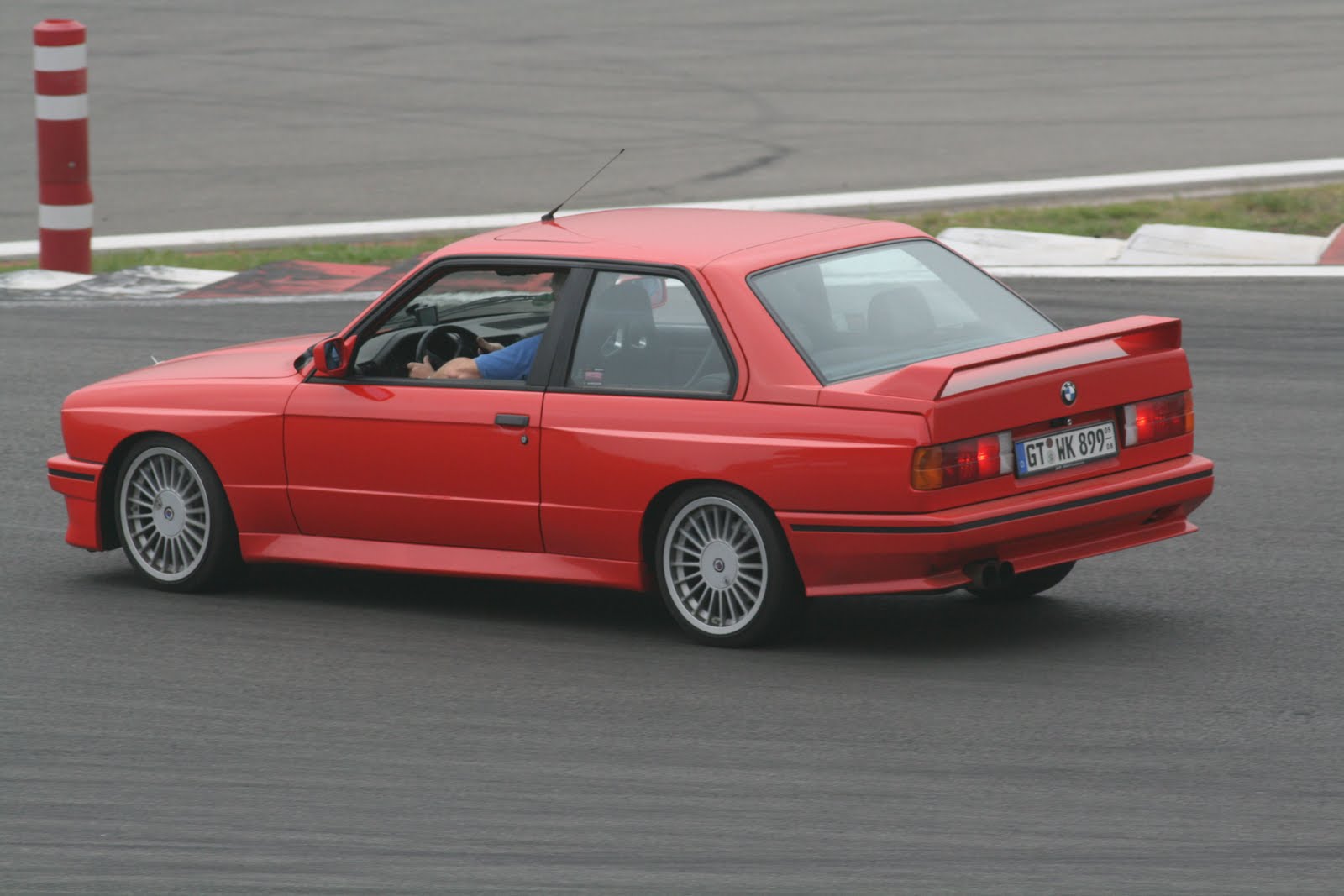
Let's go back and look at some older offsprings and famous evolution and homologation specials. For example the unforgettable BMW M3 E30 in 2.3 and 2.5 liter disuise. BMW built this car as the basis for motorsports and when you drive one of these you can fell this is true.
Or take the Porsche 924 Carrera GTS. A true racing car with road registration. Hotter than the GT which already was a pretty exciting car.
One of the most famous homlogation specials probably was the Porsche Carrera RS 2.7 liter, built between 1972 and 1973. It was planned to build 500 of them, but demand was so big that more than 1'300 were built and the racing career was a long lasting one with many special versions built on top.
Ferrari build many evolution and homologation cars, i.e. the 250 SWB or the F40. All of them have been competitive and attractive as well.
What all of these have in common are a good amount of race pedigree and steep price developments. A very good evolution model of the M3 for example can easily fetch almost the price as "new", Porsche 924 Carrera GTS have already gone beyond that. And we all know how much a good Ferrari 250 SWB or even an F40 is worth today. The Porsche Carrera RS 2.7 is traded higher than USD 200'000 today, 4-5 times of the price for the new car.
So, as a summary, true homologation specials and evolution models are cars without compromise, designed to win on the track and to offer a minimum amount of comfort and convenience anywhere else. Collectors love these things and even when the car is not competitive compared to modern sports cars, driving one of them is awesome and very rewarding.
So, if you plan to buy a Audi TT RS, maybe you reconsider, buy a normal TT and an M30 E30 on top.