 It was a lot of hard work, but now its available for public use: www.zwischengas.com. It's targeted towards German language readers, but the pictures are of course multi language. Have a look and you will understand that my blogging frequency went down over the last weeks.
Showing posts with label historic motor sports. Show all posts
Showing posts with label historic motor sports. Show all posts
Wednesday, December 22, 2010
www.zwischengas.com officially launched
It was a lot of hard work, but now its available for public use: www.zwischengas.com. It's targeted towards German language readers, but the pictures are of course multi language. Have a look and you will understand that my blogging frequency went down over the last weeks.

Sunday, November 28, 2010
Devin D restoration project for sale - now on ebay
 I have been writing about this Devin D restoration project before. It's a very rare find! It has been with the same owner since 1973 and comes with a clear title identifying the car as the number 20 of totally 49 Devin Ds every built. It will make a splendid vintage racer, but could also be finished as a street car. Of course, there's some work to do, but the components are available.
The odometer apparently reads only 1139 miles. The car had been raced in original red with black interior and also with Porsche silver with burgundy accents. The car had been prepared to re-paint when the current owner bought it. The instruments, wipers, windshield and other components where remove to sand and refinish. The car has remained in this condition to this day. There is an additional windshield glass from 1956 Porsche Speedster, full top, bows and side-curtains. There are other additional parts, such as exhaust and muffler and other sundry parts.
So, if you are in the market for a rare vintage racer (I know of only two D Devins in Europe) then here's an opportunity to acquire a fantastic platform to start with.
As said, it's on ebay now. Have a look.


Monday, November 8, 2010
One that you can buy - Amilcar C6 Grand Prix Car
 Here's again a car, that is for sale. It attracted my attention because it has a lovely patina and combines Grand Prix feeling with a road registration. It's a 1927 Amilcar C6 with a straight six cylinder engine with a double overhead camshaft, a dry sump system and a compressor. When the C6 was launched in 1926 it achieved no less than 74 victories in that year, such as the Italian Grand Prix, the Provence Grand Prix and the Brooklands 200 Miles. The C6 was also the first 1100ccm car to go reach speeds above 200 km/h.
The car for sale at VDV is in completely original state, with a fully reconditioned engine. There's no mentioning of the sales price, but it won't come cheap, but could be worth every penny!
Tuesday, October 19, 2010
With the GT40 at Le Mans - difficult to beat this
The Ford GT40 is one of the all time best sportscars ever. Not only did it win Le Mans more than once it also successfully competed on many other racetracks around the world. And you could even drive the car on the road. It looked good as well, but, Gee, the sound was just incredible, as the enclosed (not new) video from a lap at Le Mans (Classic 2008) clearly points out:
Monday, October 4, 2010
Soon available - zwischengas.com - online portal for friends of classic cars and historic races
We have been working a lot over the last months, but soon we can present the results of our efforts: www.zwischengas.com. This will be an online platform for German reading classic car addicts and friends of historic racing. We have scanned and digitized more than 120'000 pages of historically important documents, have searched through large archives and edited sound and video documents to create what we think the most comprehensive online information repository covering 100+ years of automobile history.
If you want to get a sneak preview, have a look at the video shown here.
If you want to get a sneak preview, have a look at the video shown here.
Monday, September 27, 2010
Hillclimb Steckborn-Eichhölzli 2010 - driving the Devin-TR up the hill
The hillclimb Steckborn-Eichhölzli is organized only every third year, so this was the first event since 2007. While the first day was extremely wet and cold, the second day enjoyed drivers and spectators with sun and more acceptable temperatures. The "track" is 2900 m long and climbs 127m. Best times were below 1:10, which means an average speed of more than 160 km/h, but even 2:00 means more than 85 km/h average speed. Three more challenging curves and three chicanes limit higher speeds. How this feels, you can watch yourself in the video:
Saturday, September 18, 2010
Langwies-Arosa in the JWF Milano GT - Arosa ClassicCar Hillclimb 2010
It's certainly one of the more selective and challenging hillclimbs in Europe. 7.8 km long, 78 curves, 450 m up the hill and a 1.2 km downwards section. No wonder the local guys are usually faster than the ones travelling from abroad. How does it feel? The video showcases the five and a half minute drive with the JWF Milano GT.
Tuesday, August 24, 2010
Highlight - World Sportscars Master race at this year's AVD Oldtimer Grand Prix at the Nurburgring
One of the highlights in this year's AVD Oldtimer Grand Prix at the Nurburgring was the World Sportscars Master race showcasing a number of Porsche 904, 906, 907 and 908, as well as many variations of Ford GT40, Lola T70 and Chevron B8/B16. What a sound! And how beautiful the cars of that age were! Have a look yourself and enjoy the movie!
Tuesday, August 17, 2010
Picture of the Week - Monza Lister Jaguar
 Isn't this a great picture? It shows a historical formula car, called Monza Lister Jaguar. It competed in the AVD Oldtimer Grand Prix at the Nurburgring 2010 against other historical formula 1 cars, but clearly outshined most of them with its impressive chrome type body. It's a great object to take pictures from. Though I must say, I am glad that I don't have to clean it after a partially rainy weekend.
Sunday, August 15, 2010
Amazing night race at this years AVD Oldtimer Grand Prix
 This years AVD Oldtimer Grand Prix at the Nurburgring showed again amazing cars and races. One of the best for me was the race for two seater sportscars on Saturday night, started at 20:30 and ending 1 hour later, so going into the night. Not only was the field of cars impressive and exciting (you can spot two Maserati Birdcage, a Lotus 19, Lister, Ferraris, HWM, Lotus, Mercedes Gullwing, and many other precious sportscars), but the sound and light were just impressive too. The drivers gave their best and made the race a thrill. That's historic motor sport as we love it. But let the pictures speak!


Friday, August 6, 2010
Here's one to buy - Crosslé 9S 1962
 Fancy a roadgoing race car? Here's a unique opportunity to buy a 1962 Crosslé 9S 1962 with road registration (Switzerland)! Crosslé is an Irish race car manufacturer, similar to Lotus or Elva, but much less known. The Crosslé designs were quite comparable to what these bigger car makers produced in the 60ies and thereafter. The car advertised in Switzerland produces a roaring 220 HP and weighs 540 kg, sounds like a good basis for great driving pleasure! I am not sure about FIA HTP though.

Saturday, July 24, 2010
Picture of the Week - Elva MK3
 Here's yet another interesting race car to see in full action: The Elva MK3. It has been racing for years in Germany and is pictured in probably its last race here at the AVD Oldtimer Grand Prix 2006. It was quite quick and so was the driver, a very friendly chap. The car had quite an impressive history, but probably had been changed quite a number of times to continue and stay in competition. I wasn't successful buying it, so it went into a museum. Elva comes from French "elle va" which means "she goes". Elva was a pretty successful maker of race cars and partially also street cars, the best known car probably was the Elva Courier, but racers rather remember these barchettas, be it the MK2, MK3, MK4 or the fabulous MK7.
Tuesday, May 11, 2010
Honda S600/S800 - or how the Japanese reinvented the sportscar
 The Honda S600/S800 is one of the smallest real sportscars in existence. 3.3 m length, 1.43 m width and 1.2 m height, combined with a 531 ccm, later 606 ccm and 798 ccm engine and an open or closed body. Can this really be a sportscar? Sounds more like a Mini doesn't it? Well, if you have ever driven (or at least heard) one then you won't doubt. The high revving engine (ca. 8'000 rpm) is able to generate an impressive performance. These cars were so good that they were used as race cars in the sixties, Denis Hulme for example won his class in 1964 at the Nurburgring 500 km race with an S600. And the journal Hobby even achieved a world speed record while test driving the car. Between 1963 and 1970 Honda built roughly 26'000 cars, of which one third were Coupés. Good cars are quite valuable these days, you can easily pay 15'000 Euros for an S600/S800 today in Europe.
The pictures shown here stem from an early sales brochure for the S500/S600.

Saturday, April 24, 2010
Picture of the week - Auto-Union C-Typ
 It almost looks like an animal, or a bat mobile. The Auto-Union C-Typ. The picture was taken at the 2009 GP Suisse.
Modern race cars don't have this amazing details anymore. Too bad!
Sunday, February 28, 2010
A holistic view on Racing - Le Mans and beyond
 A friend of mine has been working hard and now came out with an impressive website, focusing on Le Mans and other sportscar racing topics. He has been collecting pictures, results and lots of other insights in the history and presence of Le Mans. Even more he collected a number of great sound files, for example here. These are absolutely fantastic! There's also lots of other stuff, including some of the best racing movies produced ever and a special section on Swiss drivers and teams at Le Mans. Have a look yourself, it's certainly worth a visit!
Saturday, November 28, 2009
Looking for an "Evolution" or "Special"? Go back in time!
 A friend of mine recently told me that the latest "evolution cars" and high end spin-offs are neither exciting nor superior anymore. He illustrated this with the not really top rated Audi TT RS, but there are many other disappointing examples like the latest Mitsubishi Lancer Evo or Subaru Impreza.
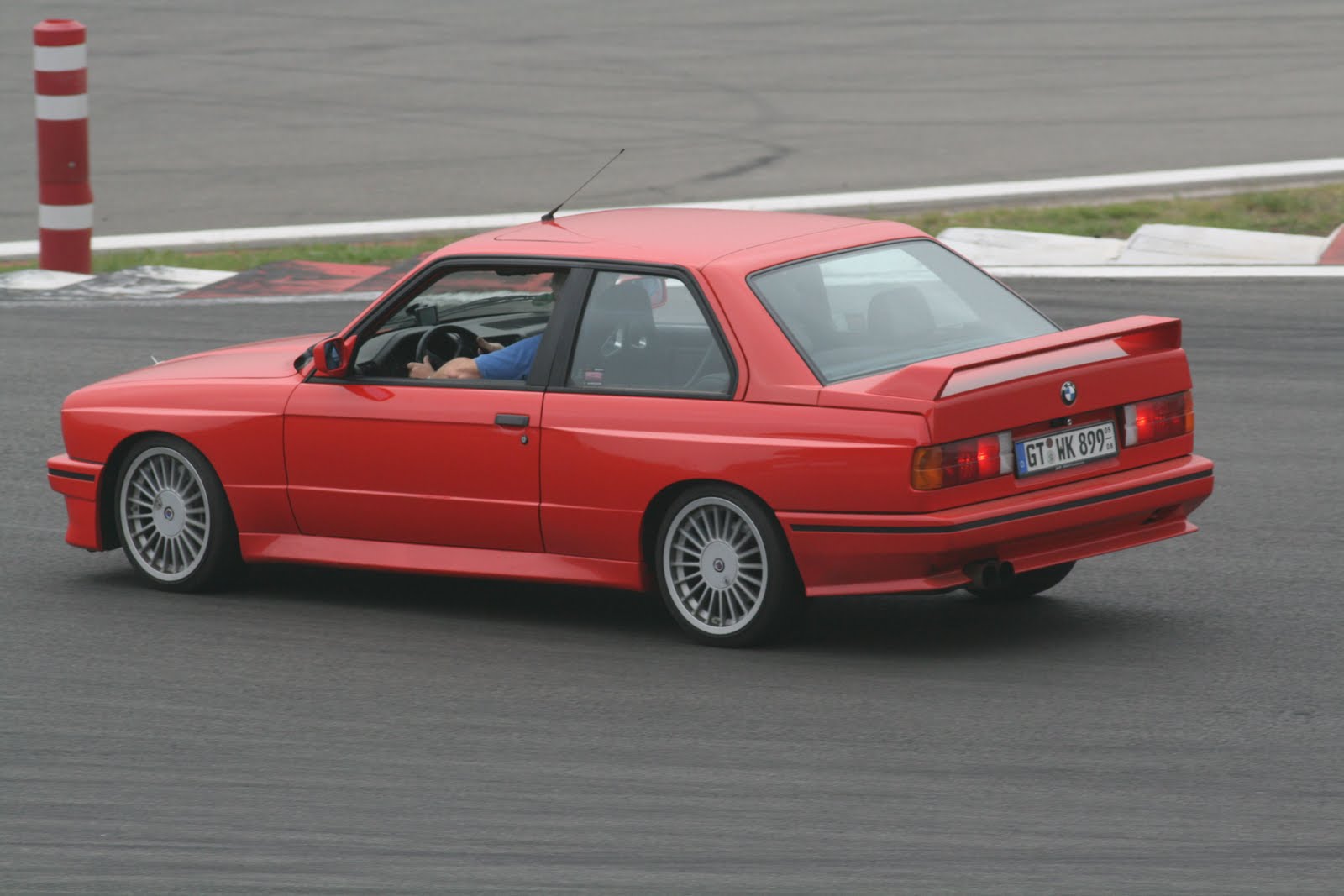
Let's go back and look at some older offsprings and famous evolution and homologation specials. For example the unforgettable BMW M3 E30 in 2.3 and 2.5 liter disuise. BMW built this car as the basis for motorsports and when you drive one of these you can fell this is true.
 Or take the Porsche 924 Carrera GTS. A true racing car with road registration. Hotter than the GT which already was a pretty exciting car.
One of the most famous homlogation specials probably was the Porsche Carrera RS 2.7 liter, built between 1972 and 1973. It was planned to build 500 of them, but demand was so big that more than 1'300 were built and the racing career was a long lasting one with many special versions built on top.
 Ferrari build many evolution and homologation cars, i.e. the 250 SWB or the F40. All of them have been competitive and attractive as well.
What all of these have in common are a good amount of race pedigree and steep price developments. A very good evolution model of the M3 for example can easily fetch almost the price as "new", Porsche 924 Carrera GTS have already gone beyond that. And we all know how much a good Ferrari 250 SWB or even an F40 is worth today. The Porsche Carrera RS 2.7 is traded higher than USD 200'000 today, 4-5 times of the price for the new car.
 So, as a summary, true homologation specials and evolution models are cars without compromise, designed to win on the track and to offer a minimum amount of comfort and convenience anywhere else. Collectors love these things and even when the car is not competitive compared to modern sports cars, driving one of them is awesome and very rewarding.
 So, if you plan to buy a Audi TT RS, maybe you reconsider, buy a normal TT and an M30 E30 on top.

Tuesday, September 15, 2009
Arosa Classic Car 2009 - one of the most challenging hillclimbs
 Four days of exciting cars to watch, four days of challenging hillclimbing, what an event, the 2009 Arosa Classic Car.
Impressive cars
Again, and similar to the years before (this was the fifth Arosa hillclimb already) a number of impressive cars have been pulled together. I really appreciated the Alfa-Romeo 8C (brought by Vögele, see picture below), the A.S.A with Ford Falcon engine (piloted by Stefan Vitelli, see picture below), the two Lancia Stratos (see picture below), the Lancia 037 Rally Stradale (see picture below), the Grand Prix Maserati (piloted again by George Kaufmann, until he had a transmission failure), the Lotus 23 (Hayoz), the ex Graham Hill Lotus Cortina (driven by Klaus Wildbolz) vintage cars like the Lagonda Rapier, American-La France, MG K3 and MG K1 monoposto, powerful AC Cobras and Ford Mustangs, as well as the really fast Ford Escort Rallye car. There are too many to mention. The full starter list is here. People also seemed to like the JWF Milano GT a lot with its slick design and impressive noise. Pictures of the cars and the event have been posted by the official photographer here.
A challenging Race Track
It's probably quite unique in Europe, a 7.8 km long hill climb. climbing 1'800 m up (and partially down) with 78 curves. The fastest cars (actually the Ford Escort RS Rallye car was the fastest) master this track in 4:30 minutes, resulting in an average speed of roughly 105 km/h. Cars like the JWF Milano GT still do it with an average speed of 85 km/h. From a driver's perspective there's not much else than an endless series of curves and hairpins. Even after having done it six times you still can't remember the full track. To get an impression on how it's like to master this 7.8 km track, have a look at the onboard video posted here.
People and location
Classic car events are not just a series of races, but also a social gathering of people loving cars. So a lot of the time is spent in either watching cars passing by, drivers preparing for start, fixing problems or just talking to each other and hear news and interesting stories.
Efficient organization
Compared to last year the organization improved a lot and it can only be said that it worked out with almost perfect Swiss precision. Few delays happened, few smaller accidents and food/drinks were extremely well organized. Also the track was very well prepared and for the type of track quite safe. So, the organizers really did a good job. Congratulation!


Sunday, September 13, 2009
Arosa Classic Car 2009 - hillclimb onboard video
I will post a more detailed report on this year's Arosa Classic Car hillclimb, but find here already some impressions in an onboard video, riding the JWF Milano GT through 76 curves up (and down) the mountain. What a track!
Friday, September 4, 2009
The AVD Oldtimer Grand Prix 2009 - Animoto Video
Playing around a bit with video tools I found (again) Animoto, that lets you create cool videos with a couple of mouseclicks. Have a look yourself whether you like the result! This one shows some of the pictures I made at this years AVD Oldtimer Grand Prix at the Nurburgring.
Thursday, September 3, 2009
The Devin TR - a Fifties American special with British ingredients
 Few people know what a Devin is, and maybe there's no such thing as a Devin anyway. But what is clear is that great cars have been built under this name and are still heavily enjoyed today.
The Man behind the cars
Bill Devin was born in Rocky, Oklahoma in 1915. Acording to Henry Manney he is "The Enzo Ferrari of Okie Flats." Bill’s father had a car repair garage and then a Chevrolet agency and the curious Bill was into cars long before his father put him to work.
Bill Devin began building cars early in his life, but he was also a passioned racing driver.
Building American cars as good as the Europeans
In 1954 Devin decided that he could build cars just as well as anybody else, especially the Europeans. He cleaned out a chicken house and got it ready to make what soon would be called Devin-Panhards. Fiberglass construction was just becoming known in the early Fifties, but Devin quickly learned about the new art by building fiberglass bodies for the Panhards. It was the first Devin fiberglass body.
Another milestone in Devin's career was the first use of a belt driven OHC engine. But, typical of Bill's disdain for paperwork and the bureaucracy, he never patented his idea which has since been used by every auto manufacturer.
The next chapter in Bill Devin's life is perhaps the one for which he is best known - the attractive, Ferrari Monza-like Devin bodies which were ultimately available in 27 variations to fit cars ranging from a tiny Crosley Hot Shot to a TR3 to a hefty Allard. Devin was easily the largest producer of fiberglass bodies in the late Fifties and early Sixties in a very competitive business. He had dealers in 50 states and shipped bodies to nearly all the countries of Europe, all through Central and South America and even South Africa.
Devin's competitors and contemporaries were companies such as Byers, Almquist, Alken, La Dawri, Microbond, Fiberfab, Atlas, Kellison, Allied, Conquest, Victress and Microplas and most have been forgotten in time, but the name Devin still features prominently as Devin held his own with the right mix of low cost and quality plus the amazing range of sizes. Devin bodies were always praised for being so smooth that they didn't even look like fiberglass and the finish work was almost always superior to his competitors.
Contrary to what many have said, Bill Devin did not set out to build a Corvette beater or for that matter a racer when he began to build the SS in 1957. The Devin SS became a famous car, but financially it wasn’t all that successful.
Many “American Specials” were built utilizing Devin bodies, the Ryan Devin Special for example or Ak Miller’s Devin Specials and the Pink Elephants. Pink Elephant IV was actually a Devin-Triumph.
Many of the Devin bodied cars were successful in American racing. Between 1956 and 1970 they were entered throughout the States and made quite an impression.
It is assumed that less then 100 cars have survived until today, approximately 5 or 6 Triumph based Devins are active in vintage racing today and always admired by the spectators.
The Devin-Triumph / Devin TR
The Devin TR on the picture was built using a Triumph TR 3 chassis and an “F” Devin body. It’s a true race car. The early history isn't fully known, but it's assumed that the car was raced from the beginning.
Race preparation includes a 2188 cc Triumph 4 cylinder motor with a flowed head and approximately 140 HP, 3.9:1 welded diff., 16 row oil cooler, Accusump pre-oiling system, on-board fire system, dual fuel pumps, fuel cell, roll bar, 15" Dunlop wire wheels, and modified TR suspension to fit the low slung body as well as disc brakes on the front and rear axle. The car is easy to drive and remarkably fast. The race history includes Sebring, Road of America, Ohio, Arosa, Gaisberg and other events.
Subscribe to:
Posts (Atom)


 Posts
Posts

