Showing posts sorted by date for query carrera gt. Sort by relevance Show all posts

Sunday, November 7, 2010

The best ever driver's car? Not an obvious choice

Here's a picture from Pistonheads. Actually they sort of borrowed it from Classic and Sportscars. C&S is celebrating the best ever driver's cars in a coming issue and that's where the foto is coming from. As you can see in the picture, the top 5 are the Alfa 8C, the McLaren F1, the Mini Cooper, the Porsche Carrera RS 2.7 and the Lotus Elan Sprint. Now, the question of course is whether we agree with this selection (and the winner RS 2.7). Difficult to say, as I haven't yet driven four of the five, at least not in the proposed disguise. But I wonder whether they didn't miss a couple of additional candidates, i.e. the Dino 246 GT or something from the 50ies for example. And, three out of five are British, but only one German and one Italian car? Seems to be a bit harsh. No Japanese car, not even the iconic Honda NSX or the Toyota GT 2000? No French car, not even the multi-times-Monte-Carlo-winner Alpine A110 1600S or one of the sought after Bugattis? No American car - well, maybe that's okay.
But, if given the choice, which of the five would I take? Probably not the McLaren and neither the Mini. Rather the Lotus or the Porsche. But my winner would be the Alfa-Romeo. Yes, I am slowly getting mature enough to fancy pre-war cars ....

Wednesday, September 15, 2010

Arosa ClassicCar 2010 - exciting cars and optimal conditions

This year's Arosa ClassicCar hillclimb enjoyed almost optimal (weather) conditions. Except for some rain on Friday for the training the sun was shining and temperatures were just right for classic cars. The Arosa hillclimb is one of the most selective and challenging ones I know off. 7.8 km long, 78 curves (though some say 76). The fastest cars, for example my favorite, the Porsche 906 (Carrera 6), run in approximately 4 minutes and 40 seconds up the hill. But even if you take 5:30 you are still doing an average of approximately 90 km/h, regardless of the three hairpins and many narrow bends. The event features regularity and competition classes. As usual most of the cars are in the regularity class, but even these pilots are trying to optimize their uphill time. As said Friday was rainy, resulting in quite some crashes during the training. My JWF Milano GT showed some misfires because of high humidity, but then got much better on Sunday finally. I actually managed to become 10th of more than 140 drivers on Saturday in regularity, by pure luck though. Sunday I successfully tried to improve my lines and speed up the hill, so didn't give anything on regularity any more. Interesting was the comparison of the JWF with the Ford Galaxie 500 starting just behind each other. The JWF almost fits into the trunk of the Galaxie, probably has only half (or less) the horsepower, but on the bendy road is clearly faster than the Falcon, no wonder, right.
Everybody I talked to was very happy and excited about the race and most probably will come back next year again. I am still in the process of compiling a little movie that I will post later on.

Saturday, May 1, 2010

Little changes made a much better car - Porsche 924 Carrera GT

Porsche had somewhat an image problem with the 924. It was not seen as sporty enough. Therefore they came up with the plan to bring the car closer to racing. To achieve the homologation of a car that stood chances in racing they built 400 (actually 406) Porsche 924 Carrera GT.
Despite the fact that the car still looked pretty much like a stock 924 there were a few design changes that made the car actually looking much more serious and fast. Anatole Lapine, design chief at Porsche, came up with new rear and front (GFK) wings and a bonnet intake for the turbo intercooler. Completed with a rear spoiler and wider wheels that pretty much was it. The fact that the drag factor and the overall air resistance was as good as the one from the stock 924 must be mentioned as quite an achievement. And it made all quite a difference. Later cars, specifically the 944, re-used some of these design elements, however in a smoother and less aggressive form.
The major changes in the CGT against the stock 924 Turbo was however the engine, producing 40 extra hp and the suspension setting, as well as the brakes, sourced from the 930 Turbo.
All in all it was a convincing package and Porsche was able to sell it at roughly the price of an 8 cylinder Ferrari 308.

Thursday, April 29, 2010

Picture of the week - Porsche 924 Carrera GT at the gas station

This is not a particularly good picture, but it's certainly one you can't take often, for three reasons: First, the Porsche 924 Carrera GT was only built 406 times in 1980, roughly 300 to 350 of these cars do still exist. Secondly, while 75 cars have been manufactured in right hand drive form for the UK (and Australia/Japan/etc.), this one is a left hand driven car with UK number plates. And thirdly, these cars are quite fuel efficient, driven on public roads. You only need to refuel the car every 700 to 900 km.
So the probability that you meet one of these cars at a gas station is really quite low, isn't it?

Wednesday, April 28, 2010

1400 km in a Porsche 924 Carrera GT in 1.5 days

I just came back from a 2 days trip to pick up the Porsche 924 Carrera GT. It took me 1'400 km roughly to drive it back to my home. So, as you would expect, I got an impression of this car. And, I am impressed. The car now is roughly 30 years old, but it is still a joy to drive and you feel both safe and well supported in this car. I must say, almost everything I read about this car, is true. The engine sound for example is not what you would dream of. It's a bit like the sound of the Alpine A110 1600 S, but I like the raspy note between 2'500 and 3'500 rpm. The handing feels absolutely state of the art, even today! I have mainly done highways and a few A and B roads, but the cars handles really nicely.
The performance is good, but what really makes your day is the boost when you reach 3'000+ rpm, the turbo wispers and off you are! That's really a sensation. I never liked turbo engines for daily driving, but if you drive for the driving's sake, then it's quite cool!
What stroke me though is the fuel efficiency of this car. I filled the thank (roughly 83 liters capacity) in the North of France and at home there was still some left after 880 km. I was able to get 70 liters in. So despite some fast touring the car stayed below 10 liters per 100 km, that's quite good!
Gear change isn't really perfect, but after some practicing you have it under control.
And it doesn't take you more than a tunnel trip to read the complete car operating manual. The various Volkswagen sourced buttons create no mysteries.
I can really understand why so many people loved this car and kept it for quite some time.

Friday, April 2, 2010

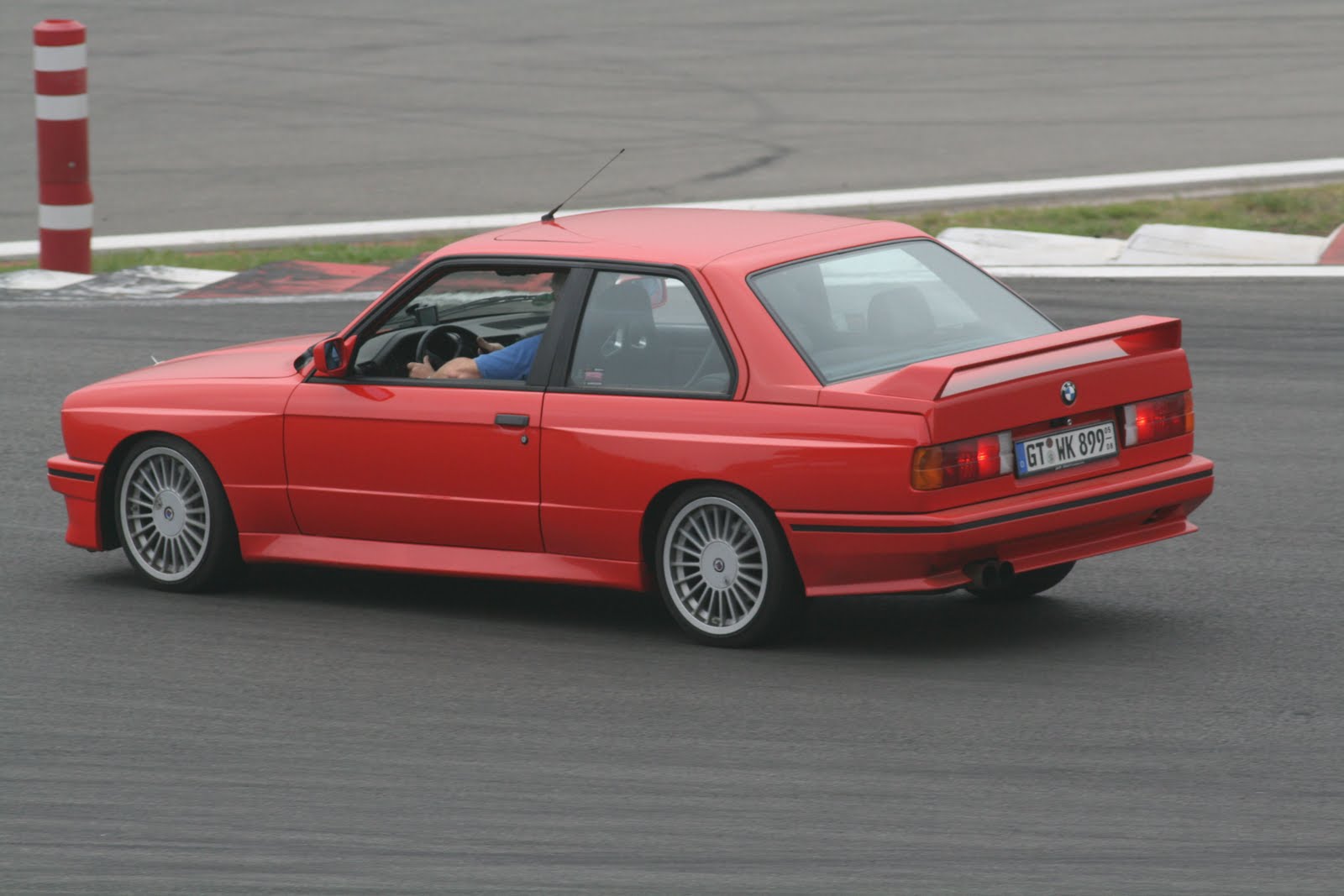
Porsche 924 Carrera GT versus BMW M3 (E30) - which one to choose?

In first sight the Porsche 924 Carrera GT and the BMW M3 (E30) seem to be difficult to compare. But when you look closer there are actually many similarities.
Both cars have been designed and built with homologation rules (FIA) in mind, so both cars are Evolution Specials. Both cars are based on a mass production everyday car, the Porsche is based on the not too popular but still well sold 924 (with Audi engine), the BMW on the very popular 3 series.
Performance of the two cars is pretty similar, despite the 7-10 years of difference in age. They accelerate in roughly 7 seconds from 0-100 km/h and reach a top speed around 240 km/h. Both cars are equipped with 4 cylinder engines. And in both cases the car manufacturers decided for more or less traditional tuning options to make the cars faster and better looking, i.e. body kits, aerodynamics improvements, engine tuning, weight saving, etc.. In both cases the result is absolutely convincing! And this is appreciated by people owning and buying these cars. Both cars hold their value much much better than their mass production sister. A well maintained M3 (E30) from 1987 to 1990 will fetch prices around Euro 15'000 to 25'000, the Porsche 924 Carrera GT typically trades between Euro 25'000 to 35'000 for examples in good condition. And, yes, both are fairly practical cars, can seat 4 people and take some luggage too. And both cars are astonishingly economical in terms of fuel consumption, at least if you believe the ECE/DIN average consumption levels.

But let's get to the differences between these cars! The Porsche 924 Carrera GT is 30 years now almost, so basically can be called an oldtimer, while the M3 still needs to wait for another 8-10 years for this "honor". While the Porsche has a turbo engine with more then 100 hp/liter, the BMW uses a high revving 4 cylinder racing oriented 4 cylinder without turbo or compressor.
The Porsche has been built 406 times and probably 90% of these cars are still around. The M3 in comparison has been produced about 17'000 times, so in terms of rarity there's quite a difference! Interestingly this doesn't impact the value too much!

If you want to buy one, then color choice will not be of great concern as the Porsche only was delivered in three colors (red, silver, black) and the M3 in only few mores (e.g. white). Condition and history are critical, as maintenance bills can become quite significant for both cars!

I have been writing about these two cars before, so if you want to read more about them, have a look here and here.

Friday, February 26, 2010

Applying Open Source to future classic cars

One key issue that drive many car enthusiasts mad is the risk that cars from the 90ies (some even say 80ies) can't be driven in a few years anymore because there are no spare parts and specialists to fix electronics problems. This is a real thread. Many of the component manufacturers have disappeared and cars become more and more complex, each part depends on other parts to work.
So here's a solution:
Why doesn't Bosch or another one of these electronics manufacturers propose a standard component platform with defined and open interfaces and deliver a sample program code to simulate what we had in cars in the past as Open Source? Car specialists or even manufacturers could take this electronics platform, adapt it to specific cars and alter the control program code to fit the purpose. As many of the car components (i.e. the CAN bus) are standardized already today this should be possible. Thanks to the fact that all code would have to be published again, more and more versions would be available and could be used for many different cars. BMW is trying to do something like this for its older race cars whereas not open source, but at least the direction is right.
So, dear car and electronics component manufacturers, please think about this and start to build a future for many great cars we have today (think Ferrari F40, Aston Martin DB7, TVR 350C, Alfa-Romeo 8C, Porsche Carrera GT, etc.).

Wednesday, February 3, 2010

Best 10 car investment opportunities for 2010

In their current issue Octane proposed "The Smart Buys of 2010". There list includes the following ten cars that they expect to rise in value: Ferrari 550, Porsche 911 Turbo, Aston Martin DB7, Jaguar Mk1 3.4, Jaguar E-Type S1/S2 FHC, Lotus Elan, Aston Martin V8 Zagato, Aston Martin V8 Virage, Ferrari 308 GT/4 and Mercedes-Benz SL (R107). While I do agree with some of these cars as good candidates to gain in value, I think the list is very "UK focused" and misses a couple of exciting investment opportunities. So here's my list as an alternative:

(1) BMW M3 (E30) - great car for everyday and exciting track cars for the special occasions, not too many were built and there's lots of racing pedigree
(2) Porsche 924 Carrera GT - I wrote about this car before, it's clearly undervalued, was produced in very little numbers and has more racing pedigree than any Ferrari since the GTO
(3) Ferrari 308 GTB/GTS - I consider these cars as still undervalued especially in comparison with some of the 12 cylinders. These cars are great to drive and less expensive to own than the bigger cars and the design is just magnificent
(4) Mercedes SL (R07) - great classics, were built over 17 years, the last ones are not only reliable but also inexpensive to own. They are not rare in comparison, but they even have catalyst converters and therefore can be driven even in protective cities
(5) Alfa-Romeo GTV 6 - again an instant classic with an unbelievable soundtrack. Not that expensive to buy, but some money is needed for maintenance. Many have disappeared appreciating the value of the remaining cars.
(6) Lotus Esprit S2, S2.2, S3 - great and fairly revolutionary shape in the 70ies, thanks to Giugiaro. S2.2 very rare, but even S2 and S3 reached small numbers in comparison to other classics. Inexpensive to own if it's a well sorted one.
(7) BMW M1 - as close to a race car as you can get. It was developed to win in racing, the road going sportscar was sort of a by-product, less than 500 cars produced make it very rare. Prices are climbing quickly though. A few years ago I was offered a M1 for less than € 50'000, now they are twice to three times this price level
(8) TVR 3000M/Taimar/3000 S - easy to own and maintain british sportscar, low number produced, especially in LHD. You can't go wrong if you buy a well sorted one
(9) Lotus Elite - less popular than the ever loved Lotus Elan, but actually much more nimble, exclusive and much closer to racing than its successor. The Elite competed in Le Mans successfully and the road car was fairly close to what the guys were using there. Prices are not too much higher than for good Elans but you get a Climax engine and lots of engineering ideas from Colin Chapman. Not a car for everybody though. But the shape is just exquisite, especially for a car of its size
(10) Aston Martin DB7 - okay, I had to take one of these onto the list. Not that it's really a great car in terms of technology and engineering, but the design is so much better than most alternatives you can buy for the same money that it's worth being considered.

So, that's the list, and of course there are many that could be added. And remember: if bought only for making money, probably none of them will bring enough interests due to all the cost that come with owning an exclusive car. But if you include your passion and pleasure in the equation, then you can forget oil, gold, platinum or any other investment ....

Saturday, January 30, 2010

Why is Porsche car design so unbalanced?

Looking at Porsche sportscars from the fifties to today it's interesting to see what worked from a design point of view and what didn't. Let's take it car by car.
The Porsche 356 was a very modern car with an aerodynamic shape and lots of innovative engineering. A master piece. Also from a design point of view. We may dislike the narrow wheels today and where they are placed at the body, but it's certainly the work of a genius.
The Porsche 911 tried to continue the basic concepts of the 356, but to modernize everything. And succeeded. Again, a design that worked over many years (until today) and looked great.
Then in the late sixties the first design failure. The Porsche 914 clearly was a modern car, but many people disliked its shape and the fact that the front and back almost look the same.
With the Porsche 924 Porsche tried again to do a low cost model and diverged from the old style engine in the back approach. The car was fairly successful and the design seemed to work. The design was improved with the Carrera GT and the 944, but finally was almost destroyed with the late facelifts (Porsche 968) that tried to bring the car closer to 911 and 928.
The Porsche 928 was a trial to finally replace the 911. Not successful. The design was very brave, very different from anything else done before by Porsche and even other manufacturers. The old Porsche fans didn't like the car and it didn't help that it was heavy and thirsty and more a GT than a sportscar. Still, the car is a design icon today.
The Porsche 959 was another attempt to create a modern variant of the 911 theme. An impressive car. And it brought some design elements coming much later with the other cars. But basically, the car was a 911 derivate.
With the Porsche 964 they tried to make the 911 ready for the 80ies but failed. It looked too fat and not slick enough. This was corrected very successfully with the Porsche 993 that brought back the old lines and inserted many modern design attributes. It's a classic already today, and being the last aircooled model probably fetching high prices for the foreseeable future.
The Porsche 996 was a bigger step, bring water cooled engines and enlarging the car along all dimensions. Many people disliked the design of the front lights and all in all it certainly wasn't the best car Porsche ever produced. It sold well however and inspired the other models of the marque, for the good and the bad.
The Porsche Boxter, showed as a prototype 1993 in Detroit, was the next attempt after the 914 and the 924 to add a line of cars below the 911. With its mid-engine layout it clearly was different than the 996, but the final design brought it closer to the 911 derivates and maybe helped to sell it. But design wise it was a big step back from the initial prototype. The Cayman shared all of the design elements.
The Porsche Carrera GT with its formula 1 style ten cylinder engine represented everything that was good about Porsche, also design wise. That's how the Boxter should have looked like. That's what could have replaced the 911 if Porsche had wanted. Not with a 10 cylinder but with modernized six cylinders.
And then came the Porsche Cayenne. Horrible. An absolute design failure. Even its twin sister Volkswagen Touareg looked so much better. The combination of typical Porsche design elements such as lights and bumpers with an SUV is difficult to digest. But from a sales point of view it worked. Interestingly enough.
With the Porsche 997 another continuation of the now more than 30 years old theme was introduced and it looked so much sharper and slicker than its predecessor. Good work for a facelift. Actually it was more than this and besides still being rear engine driven everything has changed over the last 30 years. But the customers continue to buy.
Finally with the need to increase production numbers even more the Porsche Panamera was presented. A four seat for door limousine in the shape of a stretched 911. Again, the design doesn't work really and the back is really a big mistake. But it sells, as many people like the advantage of four doors. How much better however the addition of a four door limousine can be done to an existing sportscar range is shown by Maserati with the current Quattroporte and Aston-Martin with the Rapide.

So what's the take away here?
Porsche designed and built some really ground breaking cars, but they also introduced designs that didn't work and were probably the work of the marketing department, not created by people with passion and love for aesthetics. The need to produce bigger and bigger numbers of cars created dependencies that make the result suffer.
Here are my all time best of Porsche:
356, 356 Abarth, RSK, 550 Spider, 904 GTS, Carrera 6, 911 Carrera RS. And with a bit more distance 924 Carrera GT and 993.

Saturday, January 23, 2010

Why do cars sound good or dull?

Great engine sound is one of the key ingredients that make an impressive car. And many even see it as music, as the artist's picture shows here. The difference between what you can hear from a Porsche Carrera RS 2.7 (1973) and a Porsche 996 (2003) is mind boggling.
Here are a couple of hypotheses to be debated:
(1) The more fuel efficient an engine the more boring the sound
(2) Straight six cylinders sound better than V6
(3) Sound engineering helps
(4) Modern electronics will replace the "natural" sound to compensate for what's missing

To make an example for (1): When you replace carburetors by a fuel injection the sound becomes less attractive, as you can see with the Ferrari 308 GTSi versus the 308 GTS, or the 512 BBi versus the 512 BB. When you improve the engine efficiency by adding a direct fuel injection then it gets worse even. So, what has been won in efficiency is lost on sound all to often. Partially this was compensated by adding technology to the exhaust system, which proves (3). Look at all the Aston-Martins and most modern Ferraris. Ever listened to a Jaguar D-Type or a JWF Milano GT? Both have straight six engines and sound great. Same with BMW engines, neither Mercedes nor Audi have been able to compete with BMW in terms of sound quality. Modern technologies such as loudspeakers in exhaust systems (and the car interior) plus sound generation computers will more and more add what is missing from the mechanical department. Which is what I mean with point (4).
But, whatever the modern sound engineer will be able to do, it doesn't replace the sensation we have listening a vintage car or 60ies sportscars driving by. Noise/music coming from mechanical components and open exhaust systems will always sound better.

Saturday, November 28, 2009

Looking for an "Evolution" or "Special"? Go back in time!

A friend of mine recently told me that the latest "evolution cars" and high end spin-offs are neither exciting nor superior anymore. He illustrated this with the not really top rated Audi TT RS, but there are many other disappointing examples like the latest Mitsubishi Lancer Evo or Subaru Impreza.
Let's go back and look at some older offsprings and famous evolution and homologation specials. For example the unforgettable BMW M3 E30 in 2.3 and 2.5 liter disuise. BMW built this car as the basis for motorsports and when you drive one of these you can fell this is true.
Or take the Porsche 924 Carrera GTS. A true racing car with road registration. Hotter than the GT which already was a pretty exciting car.
One of the most famous homlogation specials probably was the Porsche Carrera RS 2.7 liter, built between 1972 and 1973. It was planned to build 500 of them, but demand was so big that more than 1'300 were built and the racing career was a long lasting one with many special versions built on top.
Ferrari build many evolution and homologation cars, i.e. the 250 SWB or the F40. All of them have been competitive and attractive as well.
What all of these have in common are a good amount of race pedigree and steep price developments. A very good evolution model of the M3 for example can easily fetch almost the price as "new", Porsche 924 Carrera GTS have already gone beyond that. And we all know how much a good Ferrari 250 SWB or even an F40 is worth today. The Porsche Carrera RS 2.7 is traded higher than USD 200'000 today, 4-5 times of the price for the new car.
So, as a summary, true homologation specials and evolution models are cars without compromise, designed to win on the track and to offer a minimum amount of comfort and convenience anywhere else. Collectors love these things and even when the car is not competitive compared to modern sports cars, driving one of them is awesome and very rewarding.
So, if you plan to buy a Audi TT RS, maybe you reconsider, buy a normal TT and an M30 E30 on top.

Sunday, November 1, 2009

Octane picks the greatest cars from 1900 to 2010 - have they got it right?

Octane Magazine just published their view on what the greatest cars between 1900 and 2010 are.
As we know picking the best or greatest is a true passion for motoring journalists. Well, let's see what they came up with. Here the top threes for every ten year since 1900:
1900-1909
Mercedes 60HP (runners-up: 1907 Vanderbilt Renault, 75HP Fiat, 60HP Napier)
1910-1919
Vauxhall Prince Henry (runners--up: Rolls Silver Ghost Alpine Eagle, Hispano-Suiza H6, Packhard Twin-Six)
1920-1929
Bentley Speed Six (runners-up: Bugatti T35, Mercedes-Benz SSK, Lancia Lambda)
1930-1939
Alfa-Romeo 8C 2300 (runners-up: Jaguar SS100, Duesenberg SJ, Mercedes-Benz 500/540K)
1940-1949
Jaguar XK120 (runners-up: Bentley MkVI, Porsche 356, Cadillac V8)
1950-1959
Lancia Aurelia B20GT (runners-up: Bentley Continental, Mercedes-Benz 300SL Gullwing, BMW 507)
1960-1969
Jaguar E-Type (runners-up: Jaguar XJ6, Lamborghini Miura, Mini Cooper S)
1970-1979
Porsche Carrera RS (runners-up: Range Rover, Lamborghini Countach, Lancia Stratos)
1980-1989
Ferrari F40 (runners-up: Ferrari 288 GTO, Audi Quattro, Porsche 959)
1990-1999
McLaren F1 (runners-up: Bugatti EB110, Ferrari 550 Maranello), Lamborghini Diablo)
2000-2010
Aston Martin V12 Vantage (Bentley Continental GT, Bugatti Veyron, Rolls-Royce Phantom)

What a selection of cars. Obviously it's very difficult to compare a Mini with a Range Rover and a Ferrari F40. So is the list really helpful? And would I agree with the journalists' selction?
Well, I fully agree that the Alfa-Romeo 8C 2300, the Ferrari F40 and even the McLaren F1 belong on such a list. But in some cases there seems to be a bit too much patriotism involved, or why would you put the Aston Martin V12 Vantage on this list, or the 200x Rolls-Royce Phantom? On the other side, some really exciting and important cars are missing, i.e. the Ferraro 250 GT SWB, the iconic 250 GTO or the Pagani Zonda that I would prefer against the Aston Martin V12 Vantage. Some cars seem to be underrated, I certainly would prefer the Lamborghini Miura against the E-Type for the 60ies, however that's a tough choice to make as these two cars are so different.
But as said, picking the greatest cars of 110 years car building history is an almost impossible task. I still love to read such articles, as so many memories are triggered.

Thursday, September 24, 2009

If money is not an issue - three all time classics to choose from

My heart has always beaten for 60ies race cars that were able to cope with regular street traffic but made a good impression on the race track too. Some of these cars probably belong to the most beautiful cars ever built. And they also have a top position on my "all times" wish list.

Let's start with the Porsche Carrera 6. It followed on the 904 but had this great flat 6 cylinder engine everybody dreams of. It was highly successful even after being replaced by 907 and 908. And it is the last Porsche with gullwing doors.
The Alfa-Romeo 33 Stradale is probably one of the most beautiful cars built overall. The engine here is even more impressive than the one from the Porsche, 8 cylinders and this unbelievable Italian soundtrack. Very few cars got built.

The last of the three cars to discuss here is the Ferrari Dino 206S. It came a few years before Ferrari actually decided to produce the 206/246 GT road car, but it had a similar silhouette. Pininfarina created a masterpiece here again. The car was very competitive and, I hear, a joy to drive.

So, should I ever win in the lottery this is certainly where I would start to ramp up my car collection.
Interestingly there are only "recreations" available from the Porsche while the Alfa and the Dino never really got copied in serious numbers. Which is surprising as you could probably buy Fiat Dino Coupés and start from there to build a Dino 206S copy at reasonable cost.

Sunday, August 16, 2009

Rare cars at Altbüron Bergprüfung 2009

This years "Bergprüfung" (hillclimb) at Altbüron was a full success. The weather was great (although hot), roughly 200 cars and 30 motocycles raced up the hill, no major accident happened. Events like Altbüron may not attract so much public interest as Goodwood or the Gaisberg race, but the cars shown were worth looking and some of theme were really rare!
It was the first outing of the JWF Milano GT in Switzerland and it didn't come as a surprise that most spectators saw it the first time and didn't really know what they were looking at. The car enjoyed the crowd with its remarkable sound and beautiful shape.
The Lagonda Rapier was one of more than 15 pre war race cars. Pre war cars make technology and engineering visible second to none.
The third car I would like to mention was the Matra-Bonnet Djet. It's said to be one of the most original Djets in existience, as it's still with the first owner and nothing was change since the car competed in the Swiss championship in the sixties.
And lastly three Enzmann 506 made it to Altbüron. These cars shared a Volkswagen chassis and a quite remarkable body shape without doors. The cars were quite quick thanks to reduced weight and increases power output of the Volkswagen and partially Porsche engines. To see three of these rare cars at one event is certainly remarkable.
Besides the cars mentioned there were also a group of Recreations/Replicas with a Kraftwerks Porsche 917, a Porsche Carrera 6, A Ferrari 330P4, to mention just a few. I also spotted a group of very beautiful Abarths (from the Möll collection) and a great many other cars you don't see every days.
So, there was something for everybody and all the drivers enjoyed the hillclimb as well, not being put under time pressure, just to drive for the sake and fun of it.
The next "Bergprüfung" will be in 2011.

Saturday, July 4, 2009

Porsche 924 Carrera GT - exciting but still undervalued?

There are great cars, everybody knows and others that are almost forgotten. One of the second kind is the Porsche 924 Carrera GT, built around 1980 on the basis of the "people Porsche" 924 that was quite far from being really exciting. But by adding 85 hp, widening the body and optimizing suspensions, brakes and interior the 924 became a seriour sports car, and in GTS and GTR disguise a proper race car even. Only 406 GTs, plus 78 GTS/GTRs were built, that's a very small number. So you would think these cars fetch high prices. Well at least the GTs don't . So if you are looking for a cool car to drive and hope to get a decent return on your investment this is certainly not the worst car to buy. And according to period tests it was really great to drive and with less than 7 seconds from 0 to 100 km/h quite quick. Go for a white one, if you find one, as this was the racing color of that time. At least myself, I have it on my list of cars to potentially buy in the near future.

Wednesday, June 10, 2009

Weight Watchers - we need to slim down our cars

Weight is one of the most critical factor in car engineering and at the same time quite underrated. Cars have become heavier and heavier over the last 30 years. And it's not that helpful. The weight doesn't only influence handling, but also fuel economy and energy to be spent for production. And of course if there's more stuff in a car there's more you have to get rid off at the end of its life cycle. So, it seems, there are more than enough arguments to make cars light. However, the contrary has happened.
An excellent illustration from a paper from the "LS-DYNA Anwenderforum (Bamberg 2008)" illustrates this. But let's take some examples.
Here's a accidental list of cars and their base weights:

Car Weight (kg)
Porsche Cayenne GTS 2225
Mercedes 350 SL 1750
Lamborghini Murcielago 6.5 V12 1750
Nissan GT-R 1740
BMW M3 1605
Toyota Prius 1400
Porsche Carrera 997 S 1350
VW Golf 1.4 TSI 1340
Fiat Punto 1.4 T 1155
Lotus Elise R 900
Morgan 4/4 1.6 880

You have to look very hard to find a car that is below 1'000 kg. And the weights in the table aren't even what you get when you receive your fully spec'd car. Extras such as navigation systems, electrical sunroofs, etc. will add addiditional weight, so that the Golf mentioned in the table may be well 1450 kg and not the 1'340 kg quoted.
Obviously it could be different, as the Connaught D-Type GT V10 with 850 kg, the Mindset with less than 900kg or other innovative cars are proving it. And you don't even need to suffer as good solutions offering both performance and comfort are possible.

So, maybe we should form an organization such as a "Car Weight Watchers Association" to focus on the weight of cars? And promote light cars and blacklist heavy ones?

Sunday, April 12, 2009

Is a classic car a good investment?

There is an ongoing debate on whether classic cars are good investments. A recent catalogue from "Oldtimer Markt" with market prices covering 4'500 models and comparing these prices with the price when new triggered some analysis on my side. I selected a few models and compared an indexed price when new with the current market price for a "condition 2" car, something that is usually to find in the market and is a well maintained car. Given this data you can draw a number of conclusions.
  • There is no real correlation between age and financial gain you can make with a car. However it is clear that it is very difficult to make money with more recent cars.
  • There is no real correlation between the price level of the new car and the return on investment. However very cheap cars have difficulties to produce high returns as they lack exclusivity.
  • It's probably not very obvious what car will become a pearl when they are new. Actually cars with really good returns on investment probably were not really loved when they were new. Other cars you would expect to be good investments aren't.
  • When moderate maintenance costs are included (to keep the car in the needed condition to remain a valuable investment) then most car fall short of being a great investment. Exceptions in my sample are Ferrari 250 GT SWB, AC Cobra 427/289, Aston Martin DB4 GT Touring, Ferrari 275 GT/B 4, Bizzarini/Grifo A3/C Strada, Porsche 356 B1600 GS GTL or the Ford Mustang Shelby GT 500. Including more costs like insurance, storage space, etc. makes the story worse.
  • To really make a competitive return on cars over a longer period only few cars qualify.
  • Interestingly cars were rather "cheap" in the past. Even when you apply cost of living indexes and the likes a Ferrari 250 GT SWB would be less than 90'000 Euros today. The comparable F40 however was sold much more expensive and by the way delivers a negative return until today.
Now, very few people who want to make money with cars, buy them new and keep them until they can sell them with a decent return. A much better performance can be achieved buying the cars mildly used at the lowest point of their price curve. Using this tactics good money could be made with many competition cars and also many exclusive sports car over the last 10 years. But that's another story.

One additional point to make - buying cars to make money is not what I would recommend. People should buy classic cars because of passion and because the want to drive them. A positive return on investment should just be a nice add-on.

Here's the list of cars analyzed:

Car Indexed price (€) Gain/loss per annum Gain/loss incl. Maintenance

Ferrari 250 GT SWB 87'585 38% 28%
AC Cobra 427 49'950 22% 19%
AC Cobra 289 39'455 18% 14%
Aston Martin DB4 GT Touring 87'532 14% 9%
Ferrari 275 GT/B 4 86'645 20% 9%
Bizzarini/Grifo A3/C Strada 86'748 11% 6%
Porsche 356 B1600 GS GTL 37'452 29% 4%
Ford Mustang Shelby GT 500 33'194 7% 3%
Allard J2X 48'600 3% 0%
Porsche 911 Carrera RS Touring 47'925 8% -1%
Alfa-Romeo 1900 C Super Sprint 60'750 0% -2%
Ferraro 250 GT/L (Lusso) 88'055 8% -3%
Chevrolet Corvette Stingray Convertible 56'782 0% -3%
Aston Martin DB4 73'161 3% -3%
Mercedes 190 SL 31'821 2% -3%
Audi Sport Quatto 175'500 -2% -3%
Alpine-Renault A110 1600 S 31'909 1% -4%
TVR Griffith 200 31'529 1% -4%
Lancia 037 Rallye Stradale 65'007 3% -4%
Mercedes 300 SL Gullwing 55'929 13% -4%
BMW M1 94'737 1% -4%
Ferrari F40 374'625 -2% -4%
Toyota 2000 GT 49'844 5% -4%
Porsche 959 378'000 -2% -5%
Rolls Royce Corniche 181'587 -2% -5%
Lamborghini Mirua P400 S 106'179 4% -5%
Mercedes 300 SL (R107) 58'122 -2% -5%
Alfa-Romeo Giulietta Spider Veloce (101) 29'526 0% -5%
Ferrari Dino 246 GT 58'996 3% -5%
BMW Z1 72'000 -3% -5%
Sunbeam Tiger Mk1 28'655 0% -5%
Maserati Ghibli SS Spider 123'424 2% -5%
TVR 3000 S 33'382 -1% -5%
Aston Martin DBS 113'613 -2% -6%
Mercedes 350 SL 36'873 -1% -6%
VW Käfer Export 13'886 0% -6%
Honda NSX 98'873 -4% -6%
Monteverdi High Speed 375 L Hemi 92'045 -1% -6%
Mercedes 280 SE 3.5 51'916 2% -6%
Ferrari 365 GTB/4 Daytona 99'048 3% -6%
De Tomaso Mangusta 81'000 -1% -6%
DKW Monza 20'154 1% -7%
Datsum 240 Z 26'325 -1% -7%
Triumph TR3 18'804 1% -7%
Ford Capri 2600 RS 22'813 -1% -7%
Porsche 911 Turbo 74'025 -1% -7%
Jaguar XK 120OTS 48'600 1% -8%
Jaguar E-Type 3.8 S Convertible 45'290 1% -9%
TVR Grantura MK2 17'768 0% -9%
Ferrari 512 BB 104'073 0% -9%
Maserati Ghibli SS 118'313 -1% -9%
Lotus Elite SE 44'743 1% -9%
Lotus Esprit S2.2 51'998 -2% -11%
Porsche 356 C Carrera 2 43'026 11% -11%
Honda S800 Convertible 12'309 1% -11%
Mercedes 280 SL Pagoda 35'871 1% -11%
BMW 3.0 CSL (bat mobile) 29'430 3% -12%
Austin Healey Sprite Mk1 12'176 0% -12%
Porsche 356 A Speedster 22'950 6% -14%
Porsche 356 A 1600 S 26'614 2% -15%
Lotus Elan S3 Convertible 29'945 0% -15%
Morgan Plus 8 (Moss) 26'392 1% -16%
Porsche 914/6 27'289 0% -16%
MG A Twincam Roadster 22'661 2% -18%
Lancia Thema 8.32 65'340 -4% -19%
Fiat 124 Abarth Rally Stradale 20'864 0% -22%
NSU TTS 11'571 2% -37%