Showing posts sorted by date for query m3. Sort by relevance Show all posts

Friday, October 29, 2010

Have we gone beyond the tipping point in automobile engineering?

Recently I was involved in a discussion on whether we have gone beyond the tipping point in automobile engineering. The question discussed was whether future cars will not be "truly" better than the cars produced today and points mentioned where things such as engine downsizing, cars getting heavier and heavier, more and more electronics taking away the fun from driving, noise restrictions, emission regulations enforcing direct fuel injections, etc..
Of course you can have many different perspectives here. Let me just mention a few:
(I) The best cars are the ones from the last decade. Cars like the Audi RS4/SE, BMW M3, Porsche 911 Carrera GT3/GT3 RS, Audi RS8 V10, Lamborghini Gallardo Superleggiera, maybe even the Bugatti Veyron, etc. have set the bar and shown what is feasible. With new laws and restrictions you can only make it worse, but barely better.
(II) The best cars come from the 50ies and early 60ies, as then racing and competition cars (especially GTs and prototype type two seaters) could be driven on the road and offered maximum driving pleasure and a great sound spectrum. Take a Jaguar C-Type or a Porsche Carrera 6 as example. And don't think about convenience and usability.
(III) The best cars are still to come as with modern computer technology they will be extremely safe, extremely convenient taking over most/all of the driver's activivities and offer full access to web, TV, sound and entertainment while moving from A to B.
All of the three perspective have some "raison d'être". And for all there are exceptions and counter arguments of course. It's all a matter of what you want and value.
However there are some facts out there as well. The Volkswagen V6 engine built into the R32 for example offered an incredible sound, which the new 4 cylinder Golf R can't match. On the other side modern sound engineering and computer controlled exhaust systems in cars such as the Maserati coupé or the Aston Martin DBS/DB9 enables interesting noise patterns as well. Or just listen to a Ferrari 430 Scuderia. And it's obvious that the current cars offer superior road handling thanks to electronics, modern tyre technology and great suspension design. And it's also clear that weight spoils driving pleasure to some extent, so a 600kg sportscar of the 60ies has certain advantages against a 2 ton Aston Martin, even if the advantage doesn't translate to better lap times.
So, it's a wide topic or as you can say in German "das ist ein weites Feld". Enjoy what you like best and let room for the others with different opinions.

Tuesday, July 6, 2010

What is better? BMW M3, Ford Sierra Cosworth or Mercedes 190 2.3 16?

Yes, the boys are back. TopGear is on air again. Last Sunday they were given the challenge to buy a family track day car on a budget of GBP 5'000.-. Well the boys arrived with a E36 M3, a Mercedes 190E 2.3 16 valve (homologation car) and a Ford Sierra Cosworth. I wonder whether you could find the Merc at apparently 3'000 GBP here as it already follows the famous E30 M3 as a collector's item. And even the E36 M3 fetches better prices than what Hamster was able to buy it for (though apparently an accident car). Anyway the challenge was fun and the winner accidental (Merc). I wonder which of the three cars you would prefer. For me it's the Mercedes 16 valve Cosworth car for it's pure racing pedigree (highly successful in touring car championship). But if they had added an E30 BMW M3 then the choice would have been more clear.

Monday, May 17, 2010

ADAC 24 Hours of Nurburgring 2010 - BMW and Ferrari win, Porsche and Audi suffer

This year's 24 hours of Nurburgring showed as always a very diverse starting grid. A highlight was the Porsche 911 Hybrid racer that almost won the race, but retired after 20 hours or so. As some of the Audi R8 LMS also suffered from various problems the victory was with BMW and its M3 GT2 car no 25. Second came in the Ferrari 430 GTC as a surprise, it was the first start of the 430 at the 24 hours of Nurburgring. A couple of Audi R8, Porsche GT3 and BMW (M3, Z4 GT3) completed the first eleven. Twelfth was the Nissan Z33 with nine laps behind the winner. And thirteenth was a Porsche GT3 RS, a street legal car, impressive! 16th was the Volkswagen Scirocco GT 24-CNG (-80% CO2), 18th the Lexus LF-A, 19th the Opel Astra OPC, 27th the first Aston Martin Vantage V8, 30st a Honda S2000. Interesting also the car coming in as 34st, it was a four door Aston Martin Rapide, driven by the Aston CEO Ulrich Bez and a couple of other chaps. The Lotus Exige burnt down in the morning, but the Ginetta G50 GT4 arrived after 112 laps, noting that the winner finished 154 laps. Average lap times of the front running cars were between 8:30 and 9:00 for the 25.378 km long track (Nordschleife and Grand Prix course coupled). As always there were hundred thousands of fans around the track making this event to a week long party. It's a unique race and probably one of the largest racing events overall on a worldwide scale, no wonder that so many prominent drivers join the race every year.

Friday, April 23, 2010

Do you want a Family-Convertible-Trackcar-Cruiser?

There's a trend to try to merge car categories these days. Convertibles and Coupés get married, designers try to squeeze four seats in a car that barely can fit two, trunk sizes need to capture multiple golf bags, trucks/4wds are merged with sportscars, etc. A good (?) example is the Ferrari California. It tries to emulate a Coupé, a Convertible and a Cruiser and to some extent a practical family car (4 seats), but is it really good in all these disciplines? Wouldn't you be better of buying let's say four cars? For example go for a track car like a BMW M3 E30 or a Lotus Exige, consider a cruiser like a Mercedes 300 SL (R107) or a Ford Mustang Convertible, choose a family car like an Audi A4 Avant and if money is left add a used Ferrari 308 GT/S if you really need a prancing horse. You would have spend less money, have less depreciation per annum, probably not much more maintenance and insurance cost (depending on the country and the condition of the cars of course) and I reckon much more fun! At least me personally I prefer to drive different cars and not always the same! Different cars also feel different and make you feel different.

Friday, April 2, 2010

Porsche 924 Carrera GT versus BMW M3 (E30) - which one to choose?

In first sight the Porsche 924 Carrera GT and the BMW M3 (E30) seem to be difficult to compare. But when you look closer there are actually many similarities.
Both cars have been designed and built with homologation rules (FIA) in mind, so both cars are Evolution Specials. Both cars are based on a mass production everyday car, the Porsche is based on the not too popular but still well sold 924 (with Audi engine), the BMW on the very popular 3 series.
Performance of the two cars is pretty similar, despite the 7-10 years of difference in age. They accelerate in roughly 7 seconds from 0-100 km/h and reach a top speed around 240 km/h. Both cars are equipped with 4 cylinder engines. And in both cases the car manufacturers decided for more or less traditional tuning options to make the cars faster and better looking, i.e. body kits, aerodynamics improvements, engine tuning, weight saving, etc.. In both cases the result is absolutely convincing! And this is appreciated by people owning and buying these cars. Both cars hold their value much much better than their mass production sister. A well maintained M3 (E30) from 1987 to 1990 will fetch prices around Euro 15'000 to 25'000, the Porsche 924 Carrera GT typically trades between Euro 25'000 to 35'000 for examples in good condition. And, yes, both are fairly practical cars, can seat 4 people and take some luggage too. And both cars are astonishingly economical in terms of fuel consumption, at least if you believe the ECE/DIN average consumption levels.

But let's get to the differences between these cars! The Porsche 924 Carrera GT is 30 years now almost, so basically can be called an oldtimer, while the M3 still needs to wait for another 8-10 years for this "honor". While the Porsche has a turbo engine with more then 100 hp/liter, the BMW uses a high revving 4 cylinder racing oriented 4 cylinder without turbo or compressor.
The Porsche has been built 406 times and probably 90% of these cars are still around. The M3 in comparison has been produced about 17'000 times, so in terms of rarity there's quite a difference! Interestingly this doesn't impact the value too much!

If you want to buy one, then color choice will not be of great concern as the Porsche only was delivered in three colors (red, silver, black) and the M3 in only few mores (e.g. white). Condition and history are critical, as maintenance bills can become quite significant for both cars!

I have been writing about these two cars before, so if you want to read more about them, have a look here and here.

Wednesday, February 3, 2010

Best 10 car investment opportunities for 2010

In their current issue Octane proposed "The Smart Buys of 2010". There list includes the following ten cars that they expect to rise in value: Ferrari 550, Porsche 911 Turbo, Aston Martin DB7, Jaguar Mk1 3.4, Jaguar E-Type S1/S2 FHC, Lotus Elan, Aston Martin V8 Zagato, Aston Martin V8 Virage, Ferrari 308 GT/4 and Mercedes-Benz SL (R107). While I do agree with some of these cars as good candidates to gain in value, I think the list is very "UK focused" and misses a couple of exciting investment opportunities. So here's my list as an alternative:

(1) BMW M3 (E30) - great car for everyday and exciting track cars for the special occasions, not too many were built and there's lots of racing pedigree
(2) Porsche 924 Carrera GT - I wrote about this car before, it's clearly undervalued, was produced in very little numbers and has more racing pedigree than any Ferrari since the GTO
(3) Ferrari 308 GTB/GTS - I consider these cars as still undervalued especially in comparison with some of the 12 cylinders. These cars are great to drive and less expensive to own than the bigger cars and the design is just magnificent
(4) Mercedes SL (R07) - great classics, were built over 17 years, the last ones are not only reliable but also inexpensive to own. They are not rare in comparison, but they even have catalyst converters and therefore can be driven even in protective cities
(5) Alfa-Romeo GTV 6 - again an instant classic with an unbelievable soundtrack. Not that expensive to buy, but some money is needed for maintenance. Many have disappeared appreciating the value of the remaining cars.
(6) Lotus Esprit S2, S2.2, S3 - great and fairly revolutionary shape in the 70ies, thanks to Giugiaro. S2.2 very rare, but even S2 and S3 reached small numbers in comparison to other classics. Inexpensive to own if it's a well sorted one.
(7) BMW M1 - as close to a race car as you can get. It was developed to win in racing, the road going sportscar was sort of a by-product, less than 500 cars produced make it very rare. Prices are climbing quickly though. A few years ago I was offered a M1 for less than € 50'000, now they are twice to three times this price level
(8) TVR 3000M/Taimar/3000 S - easy to own and maintain british sportscar, low number produced, especially in LHD. You can't go wrong if you buy a well sorted one
(9) Lotus Elite - less popular than the ever loved Lotus Elan, but actually much more nimble, exclusive and much closer to racing than its successor. The Elite competed in Le Mans successfully and the road car was fairly close to what the guys were using there. Prices are not too much higher than for good Elans but you get a Climax engine and lots of engineering ideas from Colin Chapman. Not a car for everybody though. But the shape is just exquisite, especially for a car of its size
(10) Aston Martin DB7 - okay, I had to take one of these onto the list. Not that it's really a great car in terms of technology and engineering, but the design is so much better than most alternatives you can buy for the same money that it's worth being considered.

So, that's the list, and of course there are many that could be added. And remember: if bought only for making money, probably none of them will bring enough interests due to all the cost that come with owning an exclusive car. But if you include your passion and pleasure in the equation, then you can forget oil, gold, platinum or any other investment ....

Sunday, January 31, 2010

Does modern car electronics limit the ability to become a classic car?

There's a heated debate between car enthusiasts whether modern car electronics limits the lifespan of cars after 1980. Bosch announced the CAN bus in 1983 and produced it from 1987 onwards. Since then many different vehicle bus systems have been standardized and implanted into cars. With the bus the previously independent components (i.e. ABS, engine electronics, traction control, etc.) are connected and need to cooperate to make the car work properly. Therefore cars became much more complex as a system. There was of course electronics in cars before the introduction of bus systems, i.e. in the electronic fuel injection (e.g. Bosch L-Jetronic and others), starting in the late sixties and popular in the 70ies and 80ies. But these components were still fairly restricted and in many case can be replaced with simpler systems should there be a lack of spare parts. The problem with "modern" electronics is threefold:

a) Electronic components age and stop to work when connections corrode or individual parts defect.

b) Many manufacturers have disappeared, and even if the manufacturer still exists then there are no spare parts available because the lifetime of many of these components was so short

c) To analyze and diagnose problems you need the right technical equipment and specialist engineers. Often neither this equipment nor the specialists are available.

An interesting example for these problems was recently given by Mario Theissen (former BMW formula 1 team lead) in Auto Motor und Sport. "We once had a Brabham-BMW in Goodwood (must have been in the 80ies, comment from the editor). It took us all the experts of our house to make it run. The problem is electronics. You need to keep the components well maintained as there are no application systems and components available anymore today." Apparently BMW is thinking about building a more modern engine control technology that can be adapted to older racing cars from different time periods to solve the problem.
And this probably will be the solution also for other cars, such as the sports cars and GTs of the 80ies and 90ies to preserve them for the future. There will be a business building such an adaptable and configurable bus system and control electronics. And there will be computer development and tuning environments to configure these systems and even optimize them to be more fuel efficient and environmentally improved. Car owners maybe will have to spend 3'000 or 8'000 Euros to adapt their car, but that's little money if they can continue to use their loved future classic for another 5 or 10 years and create the base for value enhancement over the years.

Two additional thoughts.
What really helps of course is the fact that modern microprocessors are much more powerful than the technology from years ago. With this it will be easily possible to emulate and simulate what has been before.
From a business point of view the effort of reengineering ancient electronics is more viable the larger the volume of cars you can equip. This sort of goes against the notion that the more exclusive a car is the more expensive it can become as a classic. So there will be some trade off here.
But the chances are good that you can continue to drive your BMW M3 E30 until it's a true classic. Let's keep our fingers crossed!

Monday, November 30, 2009

Investing in a BMW M3 E30? Think again!

Investing into a future classic car seems like a good idea. Let's take the BMW M3 E30, one of the best homologation specials on the market. It's an icon of the 80ies touring car scene. Awesome to drive, good to look at, even 20 years after its birthday.
And the value is increasing continuously. The cart shows (in green) how the money you have to put down for an M3 in good shape went up since 2000. And it can be expected that the value continues to increase.
So, this would be an ideal candidate to invest in, right?

Well, no. If you only assume reasonable cost to keeping the car in good shape (garage, basic maintenance, insurance, etc.) you will spend much more money on the car than what you can ever get back for selling it. That's the nature of car ownership. Doing nothing is not an option, storing it outside is a good idea neither.
So if you are looking for a good investment and you don't like stock certificates then maybe consider watches or stamps.
However, if you are also looking forward to having fun then owning a car like the BMW M3 might be one of the financially quite attractive hobbies and that's what it is meant to be. "Freude am Fahren" (driving with passion).

Saturday, November 28, 2009

Looking for an "Evolution" or "Special"? Go back in time!

A friend of mine recently told me that the latest "evolution cars" and high end spin-offs are neither exciting nor superior anymore. He illustrated this with the not really top rated Audi TT RS, but there are many other disappointing examples like the latest Mitsubishi Lancer Evo or Subaru Impreza.
Let's go back and look at some older offsprings and famous evolution and homologation specials. For example the unforgettable BMW M3 E30 in 2.3 and 2.5 liter disuise. BMW built this car as the basis for motorsports and when you drive one of these you can fell this is true.
Or take the Porsche 924 Carrera GTS. A true racing car with road registration. Hotter than the GT which already was a pretty exciting car.
One of the most famous homlogation specials probably was the Porsche Carrera RS 2.7 liter, built between 1972 and 1973. It was planned to build 500 of them, but demand was so big that more than 1'300 were built and the racing career was a long lasting one with many special versions built on top.
Ferrari build many evolution and homologation cars, i.e. the 250 SWB or the F40. All of them have been competitive and attractive as well.
What all of these have in common are a good amount of race pedigree and steep price developments. A very good evolution model of the M3 for example can easily fetch almost the price as "new", Porsche 924 Carrera GTS have already gone beyond that. And we all know how much a good Ferrari 250 SWB or even an F40 is worth today. The Porsche Carrera RS 2.7 is traded higher than USD 200'000 today, 4-5 times of the price for the new car.
So, as a summary, true homologation specials and evolution models are cars without compromise, designed to win on the track and to offer a minimum amount of comfort and convenience anywhere else. Collectors love these things and even when the car is not competitive compared to modern sports cars, driving one of them is awesome and very rewarding.
So, if you plan to buy a Audi TT RS, maybe you reconsider, buy a normal TT and an M30 E30 on top.

Tuesday, November 3, 2009

The not yet announced (sports) cars I am really waiting for

Over the year many manufacturers announce new cars to be delivered this, next or even next after next year (i.e. the new McLaren). But there are also cars, I am really thrilled finally seeing, that haven't been announced yet. Here's a list to start the discussion:
1) New Lotus Elise/Exige
2) The successor of the Lamborghini Gallardo
3) The coming below 1'000 kg Ferrari super car
4) The Honda NSX successor
5) A true BMW M3 (E30) successor

Actually I got out of ideas quicker than expected. But maybe somebody else can extend the list?

Tuesday, August 4, 2009

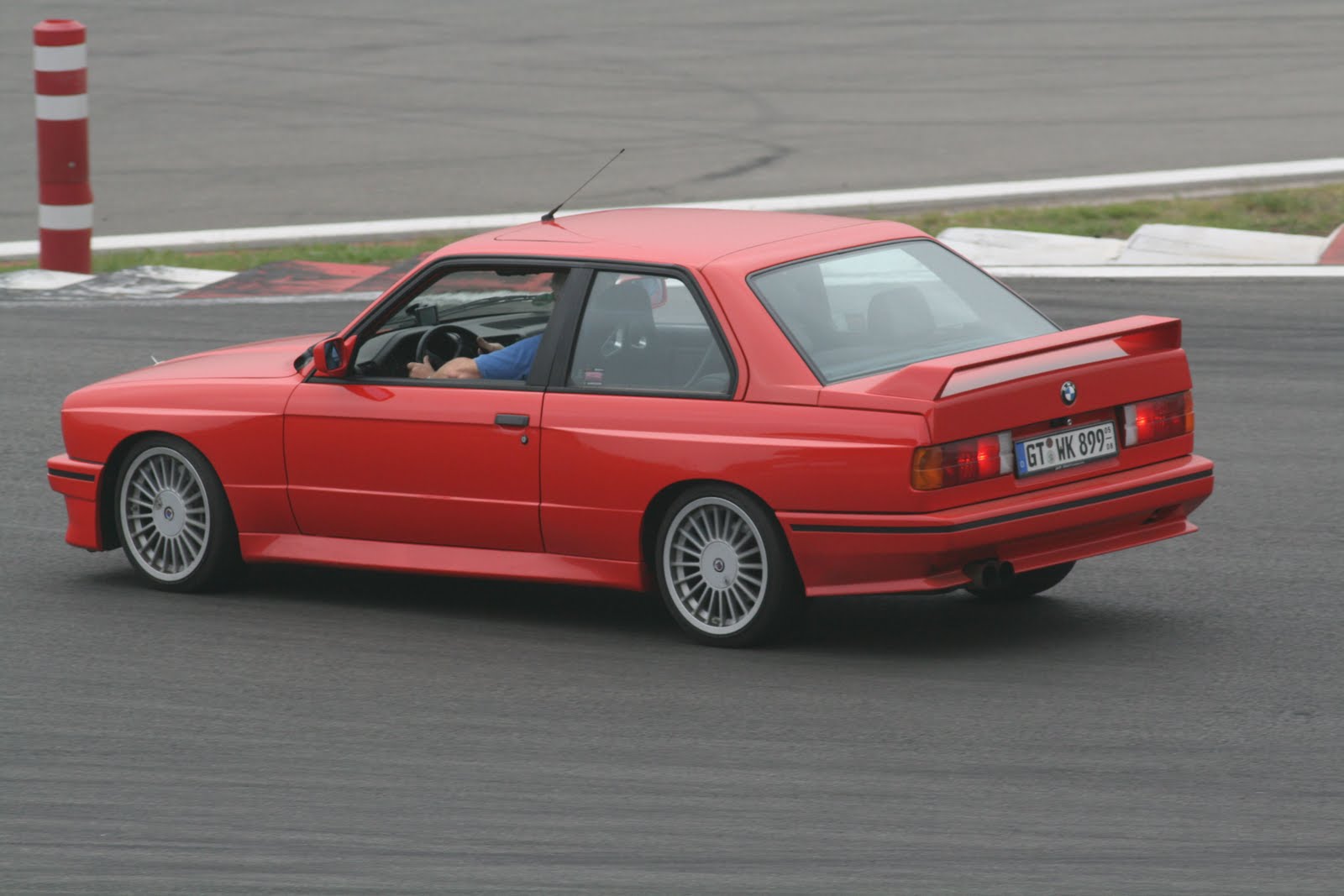
The original BMW M3 - as close to racing as a saloon car can get

When BMW launched the BMW M3 (E30) in 1986, the idea was not to sell thousands of them, but rather to create the basis for success in motorsports. In fact the first M3 was a homologation model for the German touringcar champion ship racing series (DTM). It delievered roughly 190 hp with a 2.3 liter four cylinder engine, a de-tuned racing engine. Compared to the normal 3 series saloon car, a number of car components were lightened, the car made stiffer and the aerodynamics was improved. The M3 looked much more "serious" than a normal 3 series BMW. People loved it and it became a very good seller. More than 17'000 E30 M3 were built and sold, many of them used in racing and for track days. With its good performance (0-100 km/ in less than 7 seconds) and pure handling it was the toy to have for many amateur sports driver. It won a lot of touring car races too, not just in the DTM, but also in other countries' series and in the European touring car championship. The successor (E36) was much more refined and less pure and was never a match for the first M3.
So, the E30 model, ideally one of the homologation specials, is the one to have and one day I will own one of these myself. It will be a great collectors' car as it combines race pedigree, rarity and good look and performance.

Sunday, July 12, 2009

Tests in Car Magazines are not neutral

A lot of people consult Car Magazines to find out what car to consider to buy, me included. Car Magazines employ well educated people with lots of experience and therefore are able to measure the performance of cars and the car’s characteristics. But why can it be that more often than not French cars win and are celebrated in French magazines, while a German car may be the winner in a German journal? Is there a lack of Neutrality?
Well, I strongly believe that these journalists have a very professional attitude and they try to stay as fair as possible. What may make the difference is, that not all criteria are the same for Germany versus France for example. Why would a French motor journalist care about the top speed of a car really? Let’s take an example: the Toyota Prius. If you apply German criteria you may want to be able to go fast on a highway and also drive very quickly on normal streets. Distances are big between cities, so you really care a bit less about city fuel consumption. People are rather tall and you need lots of space for all the stuff a family wants to take for vacation. The Prius will not score well here. In Japan it’s very different. Lots of city traffic, impossible to drive faster than 100 km/h, smaller people and probably no need to take the car when you do vacation trips. So the test result will be quite different in these two cases. Another good illustration is what TopGear did when comparing the Toyota Prius and the BMW M3 on the race track: the Prius going full speed followed by a relaxed M3 resulted in more fuel consumption with the Hybrid than with the tuned six cylinder engine of the BMW. Actually as a reader you may not even care about neutrality as long as the criteria applied fit to your own needs. And yes, there’s some national pride involved too and probably some sponsoring and advertisement money as well. So it’s good that the readers have their own opinions also and often read a number of different journals anyway.

Sunday, June 21, 2009

Classic cars and their value over time

In my experience there are three basic scenarios for cars on how they will depreciate, respectively gain in value. By the way, of course cars of this category can increase in value beyond the initial sales price. We have recently seen low mileage Mercedes 300 SL (R107) offered for more than 50'000 Euros, which is clearly more than the 60-70'000 DMs (30-35'000 Euros) that were asked for a new car in the 80ies.

Scenario C (red)
The car is an instant classic and collector's item. There's much more demand than market from begin on. The car never really drops in value and typically gains a bit in a continuous way. Few cars really fall in this category. Some seem to belong in there in the beginning when people are paying premium prices to get an early one, but most of them then still depreciate. Exceptions probably are the Ferrari Enzo (?), Ferrari F40, McLaren F1. But as said very few cars make it into this category.

Scenario B (green)
Cars that fall into this category are usually neither volume cars nor everyday cars. They typically are pretty rare from the beginning and bring some sensation with them. Many if not most of them are either convertibles or sportscars. While they do depreciate over the first 10-20 years they still lose less value than the mass production cars. They are always sought after during their whole career. After some years they start to continuously gain in value and can actually even outperform their initial sales price. Cars that fall into this category are the Mercedes SLs (R113, R107), the Porsche 911 and derivates, TVR 3000 S, Morgan +8, BMW M3 (E30), BMW Z1, BMW M1, most Ferraris, some Lamborghinis, some Maseratis, etc.). You get the picture.

Scenario A (blue)
This is the most common scenario. Most cars actually fall into this category. From begin on they depreciate (rather fast) and reach over the years (let's say 7 to 15) the bottom, a fraction of their initial sales price. Some then become collector's items and raise in value quickly, some others slower. If you take a Volkswagen Golf Mk1 for example, this car has been produced in millions, but after 20 or 30 years only a handful remain in a market and they become somewhat exclusive. So their value increases and can actually become higher than the initial sales price. In the exhibit this is illustrated with graph A1.
A very special category are race cars. Quite expensive when new they have almost no value after few years and can be purchased for very little money sometimes. This was especially true in the late sixties and the seventies, when Ferrari GTOs or Porsche 904/906 were on the market for a few thousand USD or DMs. Thanks to the developments are historic racing some of these became later very expensive. The Porsche 906 was sold for roughly 30'000 DMs when new, changed hands for maybe 6'000 DMs in the late sixties and is today valued at around 600'000 Euros (multiply with 2 for DMs). This is indicated by graph A2.
Cars in this category are everything from the Volkswagen Beetle, to Fiat 850 Sport Spider or Ford Mustangs. But it includes also cars like the mentioned Porsche 904/906, the Lotus Eleven or the prewar race cars. Actually cars that can't make it into B or C end up in A. Or they disappear totally.

Now there is one comment to be made: To really gain substantial value over time the car must remain in driving condition and often needs to be restored multiple times. The cost for maintaining or restoring the car can be easily higher than the value gain driven by it. And even if the car is barely used it will still ask for quite a bit of maintenance and a dry garage and insurance and .... So, if you are only interested in cars for making money, you may be better in buying something else. But if you like cars and love to drive them, making money with them is just a bonus on top and of course makes the hobby even more attractive. See also my previous post on a comparison of cars and their value when new and now.

Monday, June 15, 2009

The three wheeler Volkswagen Scooter from 1986 would be a revolutionary car even today

In 1986 Volkswagen presented an experimental vehicle called "Scooter". It was quite innovative. It's drag factor (cw) was 0.25. Its weight was 550 kg, and the production version was claimed to be even lighter. It had three wheels only and could seat two people. With a small engine it was said to be very economical and still quite fast. But - it never made it to production. And probably wouldn't have been a big seller if Volkwagen had decided to manufacture it. In 1986 it would have competed with the Volkswagen Golf II, the BMW 325i, the first BMW M3, the Citroen BX, the Peugeot 505, the Mercedes 300 SL (R107) oder the Lamborghini Countach. Interestingly all of these competitors look quite old now, and some are true "Youngtimers" now. The Volkswagen Scooter though still looks futuristic and would still today be a vehicle that could win economy runs and with today's engine technology could make a "less than 100g CO2 per km" car, probably more ecological than a Toyota Prius. It's sad to see how many good ideas and concepts never materialize.

Wednesday, June 10, 2009

Weight Watchers - we need to slim down our cars

Weight is one of the most critical factor in car engineering and at the same time quite underrated. Cars have become heavier and heavier over the last 30 years. And it's not that helpful. The weight doesn't only influence handling, but also fuel economy and energy to be spent for production. And of course if there's more stuff in a car there's more you have to get rid off at the end of its life cycle. So, it seems, there are more than enough arguments to make cars light. However, the contrary has happened.
An excellent illustration from a paper from the "LS-DYNA Anwenderforum (Bamberg 2008)" illustrates this. But let's take some examples.
Here's a accidental list of cars and their base weights:

Car Weight (kg)
Porsche Cayenne GTS 2225
Mercedes 350 SL 1750
Lamborghini Murcielago 6.5 V12 1750
Nissan GT-R 1740
BMW M3 1605
Toyota Prius 1400
Porsche Carrera 997 S 1350
VW Golf 1.4 TSI 1340
Fiat Punto 1.4 T 1155
Lotus Elise R 900
Morgan 4/4 1.6 880

You have to look very hard to find a car that is below 1'000 kg. And the weights in the table aren't even what you get when you receive your fully spec'd car. Extras such as navigation systems, electrical sunroofs, etc. will add addiditional weight, so that the Golf mentioned in the table may be well 1450 kg and not the 1'340 kg quoted.
Obviously it could be different, as the Connaught D-Type GT V10 with 850 kg, the Mindset with less than 900kg or other innovative cars are proving it. And you don't even need to suffer as good solutions offering both performance and comfort are possible.

So, maybe we should form an organization such as a "Car Weight Watchers Association" to focus on the weight of cars? And promote light cars and blacklist heavy ones?